
PRP Therapy is often described as a “natural” aesthetic treatment because it uses platelet-rich plasma prepared from your own blood sample. But PRP is not one single treatment. At Classy Cosmetic Clinic, PRP Facial and PRP Hair Restoration are approached as two separate services with different goals: one focuses on skin quality, while the other focuses on scalp and hair thinning support.
If you are researching PRP Therapy in Thornhill or PRP Newmarket options, the most important first step is understanding which concern you want to address. Skin texture, dullness, early fine lines, acne-scar texture, hair thinning, and hair shedding are not the same concern. They require different assessment, treatment planning, and expectations.
Quick Answer
PRP, or Platelet-Rich Plasma, is prepared from a small sample of your own blood. The sample is processed to separate plasma that contains platelets and growth factors. PRP may be used in aesthetic medicine to support skin quality in a PRP Facial or scalp and hair quality in PRP Hair Restoration .
PRP Facial and PRP Hair Restoration should not be marketed as the same treatment. A consultation is recommended to determine whether your concern is skin-related, scalp-related, or better suited to another treatment.
What Is PRP?
PRP stands for Platelet-Rich Plasma. Platelets are blood components involved in healing and tissue repair. In a PRP treatment, a small amount of blood is drawn and processed in a centrifuge to separate the platelet-rich portion from the rest of the blood.
This concentrated plasma may then be applied to or injected into a selected treatment area, depending on the service and treatment plan.
PRP does not contain dermal filler. It is not Botox. It does not relax facial muscles, add structural volume, or replace surgical procedures. Its role is different: it may support skin quality or scalp and hair quality depending on how it is used.
Good to Know
PRP is prepared from your own blood sample, but that does not mean it is suitable for everyone. Medical history, medications, platelet function, active skin or scalp conditions, and treatment goals all matter.
How PRP Is Prepared
The preparation process usually follows a structured sequence:
- A small amount of blood is drawn.
- The sample is placed into a centrifuge.
- The centrifuge spins the sample to separate blood components.
- The platelet-rich plasma is collected.
- The PRP is used according to the treatment plan.
For a PRP Facial, the plasma may be applied to the skin with microneedling or delivered through small targeted injections depending on the plan. For PRP Hair Restoration, PRP is typically placed into selected scalp areas where thinning support is being considered.
Technique, preparation, and patient selection matter. That is why PRP should be treated as a professional medical aesthetic service, not a casual beauty add-on.
PRP Facial: Skin Quality and Texture Support
PRP Facial focuses on the skin. It may be discussed for clients who want gradual support for texture, tone, dullness, early fine lines, and overall skin quality.
- A PRP Facial may be suitable for clients concerned about:
- Uneven-looking texture
- Dull or tired-looking skin
- Mild fine lines
- Skin freshness
- Collagen support
- Minor acne-scar texture
- Overall skin rejuvenation support
The goal is not instant transformation. PRP Facial is better understood as a gradual skin-quality treatment. Some clients may need a series, and results vary depending on skin condition, age, lifestyle, treatment method, and healing response.
PRP Facial may also be discussed alongside microneedling when the goal is texture support. If hydration and skin smoothness are the main concerns, skin boosters may also be discussed during consultation.
PRP Hair Restoration: Scalp and Thinning Support
PRP Hair Restoration focuses on the scalp and hair thinning concerns. This service is different from PRP Facial, even though both use Platelet-Rich Plasma.
PRP Hair Restoration may be discussed for selected clients with early or moderate thinning, reduced density, visible scalp, or increased shedding. It is not a guaranteed hair growth treatment, and it does not replace medical diagnosis, prescription treatment, or hair transplant surgery when those options are more appropriate.
A consultation may include discussion of:
- Pattern of thinning
- Timeline of hair changes
- Family history
- Scalp condition
- Medical history
- Medications or supplements
- Previous hair treatments
- Expectations and maintenance
PRP Hair Restoration is often discussed as a series rather than a single appointment. Maintenance may also be recommended depending on response and goals.
Important
PRP Facial and PRP Hair Restoration use the same source material, but they are different treatments with different goals, treatment areas, timelines, and suitability considerations.
PRP Facial vs PRP Hair Restoration
| Category | PRP Facial | PRP Hair Restoration |
|---|---|---|
| Primary focus | Facial skin quality | Scalp and hair thinning support |
| Treatment area | Face and selected skin areas | Scalp |
| Common goals | Texture, tone, dullness, fine lines, skin freshness | Early thinning support, scalp quality, hair density support |
| How PRP is used | Applied with microneedling or placed through targeted skin injections depending on plan | Placed into selected scalp areas |
| Result timeline | Gradual skin-quality support | Gradual scalp and hair-quality support |
| May be combined with | Microneedling, skin boosters, selected skin treatments | Hair-care planning or other hair-loss approaches if appropriate |
| Not intended for | Facial volume loss, deep folds, muscle movement lines | Guaranteed hair growth, baldness reversal, or replacing medical diagnosis |
| Consultation focus | Skin condition, texture, tone, acne-scar texture, sensitivity | Type of thinning, scalp condition, shedding history, expectations |
Patient Expectation
PRP Facial and PRP Hair Restoration can both be useful conversations, but they should not be merged into one “PRP does everything” message. The treatment goal must be clear before any plan is recommended.
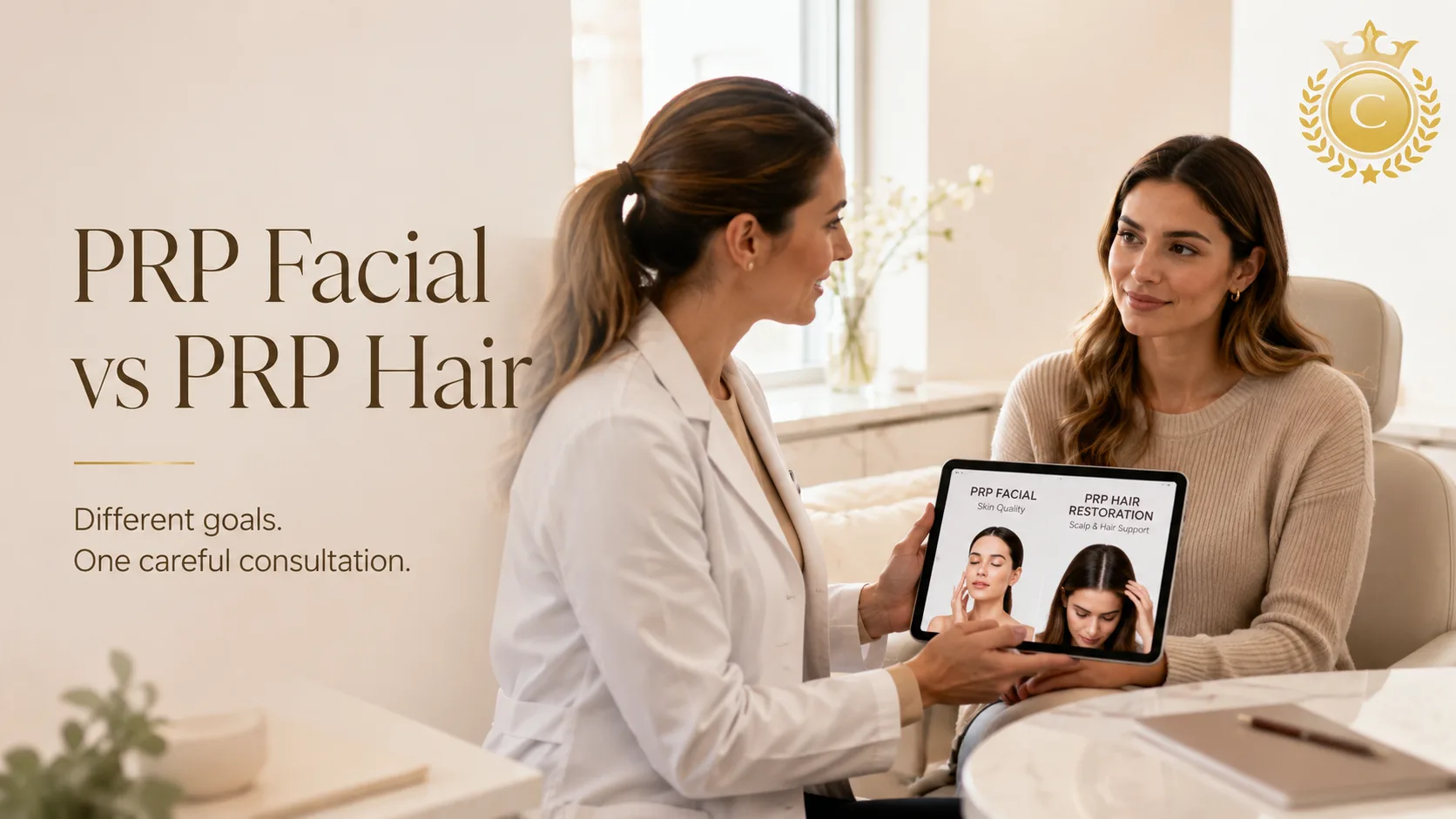
Which Concern Matches Which Treatment?
| Concern | Treatment That May Be Discussed |
|---|---|
| Hair thinning or visible scalp | PRP Hair Restoration |
| Increased hair shedding | PRP Hair Restoration or medical evaluation depending on cause |
| Dull or tired-looking facial skin | PRP Facial |
| Uneven texture or enlarged-looking pores | Microneedling or PRP Facial |
| Acne-scar texture | Microneedling, PRP Facial, or staged skin treatment planning |
| Fine lines related to skin quality | PRP Facial, microneedling, or skin boosters |
| Facial volume loss | Dermal Fillers |
| Under-eye hollowness | Under-Eye Filler after assessment |
| Hydration and skin smoothness | Skin boosters or other skin-quality treatments |
| Movement-related wrinkles | Botox or wrinkle-relaxing treatment may be discussed separately |
This table is educational only. The right treatment depends on assessment, not a symptom list alone.
Does PRP Contain Medication?
PRP is prepared from your own blood sample and does not work like a prescription medication, dermal filler, or neuromodulator. It does not contain Botox, hyaluronic acid filler, or synthetic volumizing product.
However, “natural” does not mean automatic or risk-free. PRP preparation requires sterile technique, proper equipment, and professional judgment. Your provider should review your medical history and explain whether PRP may be suitable for you.
Who May Benefit from PRP Therapy?
PRP Therapy may be considered for selected clients who want gradual support for skin or scalp concerns and understand that outcomes vary.
PRP Facial may be considered by clients who want to support:
- Skin texture
- Dullness
- Tone
- Freshness
- Mild fine lines
- Minor acne-scar texture
- Overall skin quality
PRP Hair Restoration may be considered by clients who want to explore support for:
- Early thinning
- Moderate thinning
- Hair shedding concerns
- Reduced-looking density
- Scalp and hair quality
A consultation helps determine whether PRP is suitable or whether another approach would better match the concern.
Who May Not Be a Suitable Candidate?
PRP may not be suitable for everyone. A provider may recommend delaying treatment, choosing another option, or seeking medical evaluation first if there are factors such as:
- Active infection or inflammation in the treatment area
- Certain blood or clotting disorders
- Medical conditions affecting platelet function
- Use of medications that may affect bleeding or healing
- Pregnancy or breastfeeding considerations
- Active skin disease or scalp disease
- Severe hair loss that may require another approach
- Unrealistic expectations
- A desire for instant or guaranteed results
This list is not meant to diagnose or exclude anyone automatically. It explains why consultation is necessary before PRP Facial or PRP Hair Restoration.
Consultation Tip
Bring clear information to your appointment: when the concern started, what has changed, what treatments you have tried, medications you take, and what result you hope to achieve. This helps the provider guide you more accurately.
What Happens During Consultation?
At Classy Cosmetic Clinic in Thornhill and Newmarket, PRP consultation begins with understanding your concern. For PRP Facial, the provider may assess skin texture, tone, acne-scar texture, fine lines, sensitivity, and treatment history. For PRP Hair Restoration, the provider may assess thinning pattern, shedding history, scalp condition, and expectations.
Consultation may also include discussion of alternatives or complementary services. For example, PRP Facial may be compared with microneedling or skin boosters. PRP Hair Restoration may involve discussion of maintenance and realistic timelines. If the concern is volume loss, dermal fillers may be a separate conversation. If the concern is under-eye hollowness rather than skin quality, under-eye filler may be discussed separately.
The purpose is not to push PRP. The purpose is to understand whether PRP belongs in the treatment plan.
Treatment Process and Comfort
The appointment usually begins with cleansing and preparation. A blood sample is taken and processed in a centrifuge. The PRP is then used according to the treatment plan.
For PRP Facial, PRP may be applied with microneedling or placed through small targeted injections. For PRP Hair Restoration, PRP is placed into selected scalp areas.
Comfort varies. Some clients feel pressure, stinging, tenderness, or a mild pinching sensation. Numbing or other comfort measures may be discussed depending on the treatment area and clinic protocol.
Recovery and Aftercare
Recovery depends on the treatment type and individual response. PRP Facial may involve temporary redness, sensitivity, dryness, mild swelling, or a sunburn-like feeling, especially when combined with microneedling. PRP Hair Restoration may involve temporary scalp tenderness, pinpoint bleeding, swelling, or sensitivity.
Aftercare may include avoiding intense exercise, heat exposure, harsh skincare, or certain hair products for a short period depending on clinic guidance. Your provider should explain what to expect and when to contact the clinic if anything feels unusual.
Can PRP Be Combined With Other Treatments?
Sometimes. PRP may be combined with microneedling when the goal is skin texture and collagen support. Skin boosters may be discussed when hydration and skin smoothness are priorities. Dermal fillers may be discussed separately when the concern is facial volume or contour. Under-eye filler may be considered only when hollowness or tear trough shadowing is the concern.
Combination treatment should be planned carefully. More treatment is not always better. The right plan may be one treatment, a staged approach, or no treatment at all.
Radiesse in Thornhill & Newmarket
Classy Cosmetic Clinic serves patients at both its Thornhill and Newmarket locations.
Thornhill:
7163 Yonge Street Suite 269, Thornhill, Ontario L3T 0C6
Newmarket:
16775 Yonge Street Suite 217, Newmarket, Ontario L3Y 8J
For patients searching for Hyperdiluted Radiesse in Thornhill or Hyperdiluted Radiesse in Newmarket, the location is only one part of the decision. The more important question is whether the treatment is appropriate for your concern.
A consultation at Classy Cosmetic Clinic helps determine whether your concern is related to skin firmness, mild laxity, volume loss, texture, or another factor. From there, the clinic can explain whether Radiesse treatment, traditional dermal fillers, Sculptra, HIFU, or another option may be more suitable.
The goal is to keep treatment planning thoughtful, medically careful, and aligned with natural-looking refinement.
Frequently asked questions
What is PRP? +
What is the difference between PRP Facial and PRP Hair Restoration? +
Is PRP natural? +
Does PRP contain medication? +
Is PRP painful? +
How many PRP sessions may be recommended? +
Can PRP be combined with microneedling? +
Can PRP Facial and PRP Hair Restoration be performed during the same visit? +
Does PRP guarantee hair growth? +
Conclusion: PRP Starts With the Right Diagnosis of the Concern
PRP Therapy can be a valuable category in medical aesthetics, but it should be explained clearly.
PRP Facial and PRP Hair Restoration are not the same service. One focuses on skin quality and natural skin rejuvenation support. The other focuses on scalp and hair thinning support.
If you are considering PRP Therapy in Thornhill or Newmarket, consultation is the best way to determine whether PRP aligns with your concern, health history, treatment goals, and expectations.
To speak with Classy Cosmetic Clinic, contact the clinic at
classycosmeticclinic@gmail.com,
call
647 909 5026,
or visit the
Contact page.