
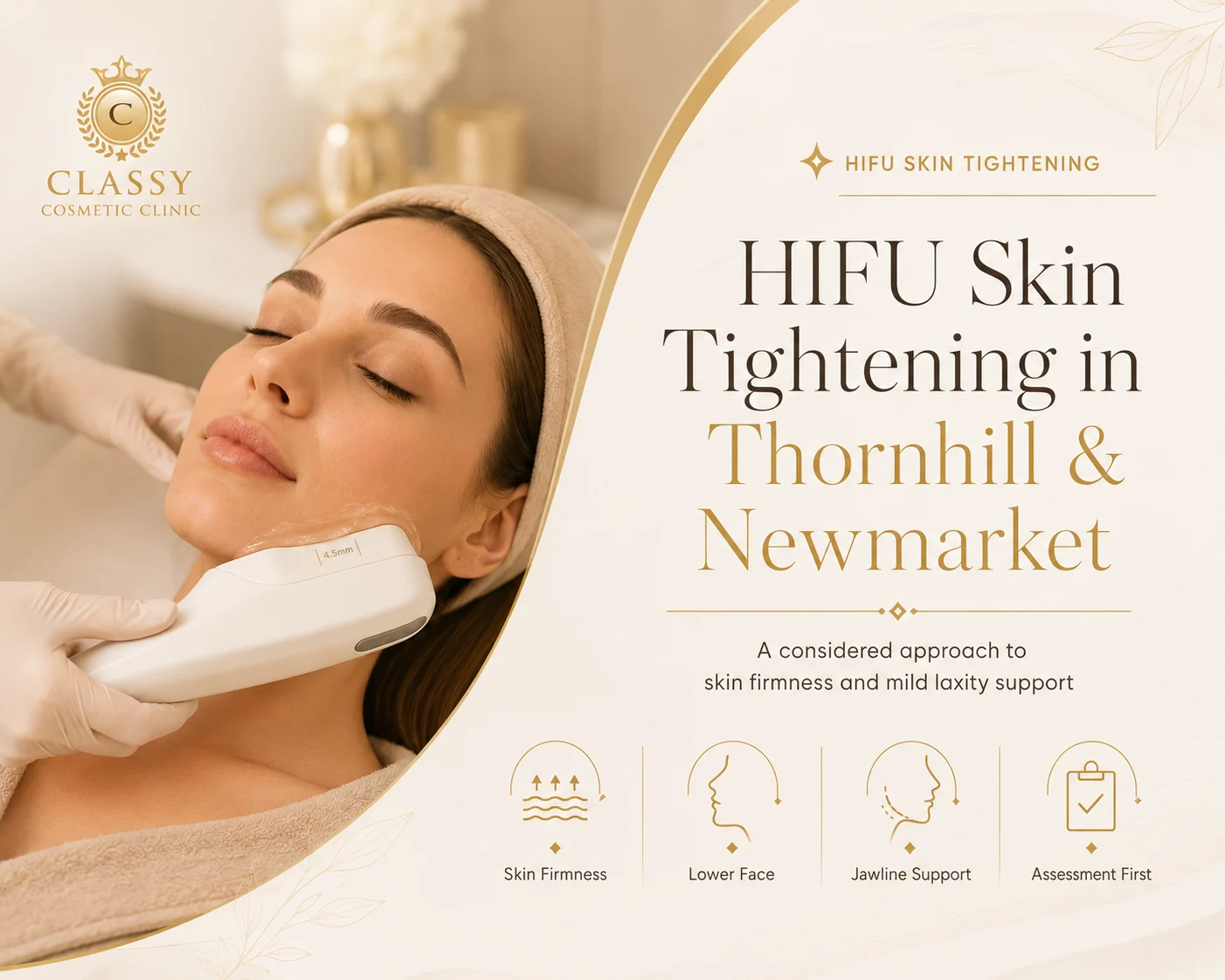
A Considered Approach to Skin Firmness
Changes in skin firmness often appear gradually. The lower face may look softer, the jawline may feel less defined, or the skin around the neck and under-chin area may appear less supported than before.
At Classy Cosmetic Clinic, serving both Thornhill and Newmarket, HIFU Skin Tightening is approached as a non-surgical option for selected clients with mild to moderate skin laxity. The treatment uses focused ultrasound energy delivered beneath the skin’s surface at selected treatment depths to support collagen remodeling over time.
HIFU does not add volume, relax facial muscles, or resurface the skin. Its role is to support firmness and improve the appearance of selected laxity concerns gradually. Treatment planning is based on your skin condition, facial structure, goals, and professional assessment.
Understanding HIFU Skin Tightening
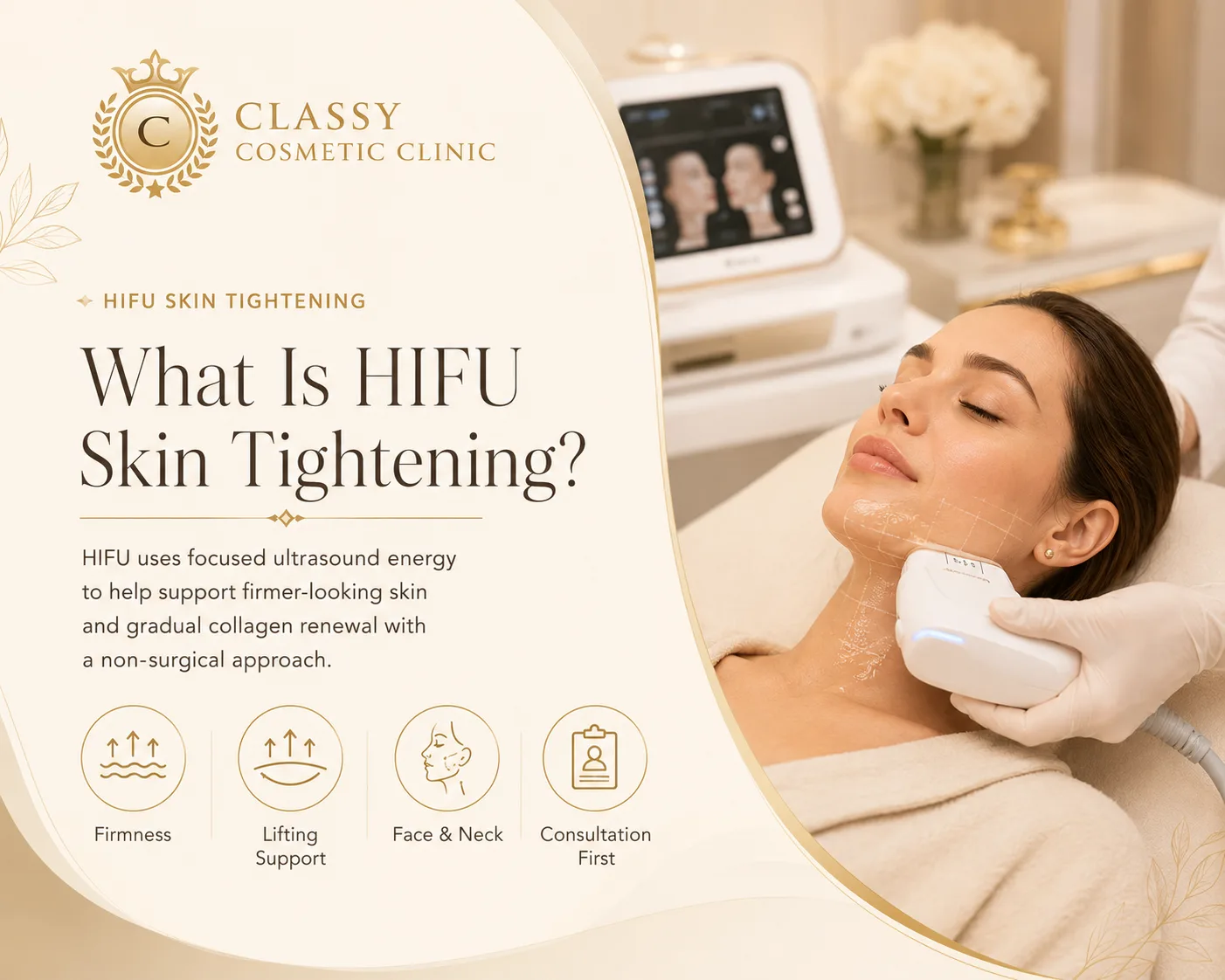
HIFU stands for High-Intensity Focused Ultrasound. It is a non-invasive aesthetic treatment that delivers focused ultrasound energy beneath the skin’s surface.
The energy is directed to selected deeper layers beneath the skin, where it creates a controlled response that may help support collagen remodeling. Collagen contributes to the skin’s firmness and structure. As the skin responds over time, some clients may notice a firmer-looking or more supported appearance.
The surface of the skin remains intact during treatment. HIFU does not involve needles, filler products, or surgical incisions. It is typically considered by clients who want to address early firmness concerns without choosing surgery.
The appropriate treatment depth, energy settings, and areas treated depend on the device protocol, anatomy, skin condition, and assessment. This is why HIFU should not be performed using a standard plan for every client.
How HIFU May Support Firmer-Looking Skin
Skin firmness is influenced by age, genetics, sun exposure, weight changes, lifestyle, and the natural changes that occur within supporting tissues over time.
HIFU delivers focused ultrasound energy beneath the skin’s surface to support collagen remodeling over time. Any visible improvement develops gradually as the skin responds.
Some clients may notice subtle changes in the weeks following treatment, while others may require more time before seeing a difference. The degree of improvement varies and depends on the starting level of laxity, skin quality, treatment area, and individual response.
HIFU is intended to support firmness, not to create a dramatic transformation. It may be appropriate for clients who want a subtle, non-surgical approach and understand that the outcome will be different from surgery.
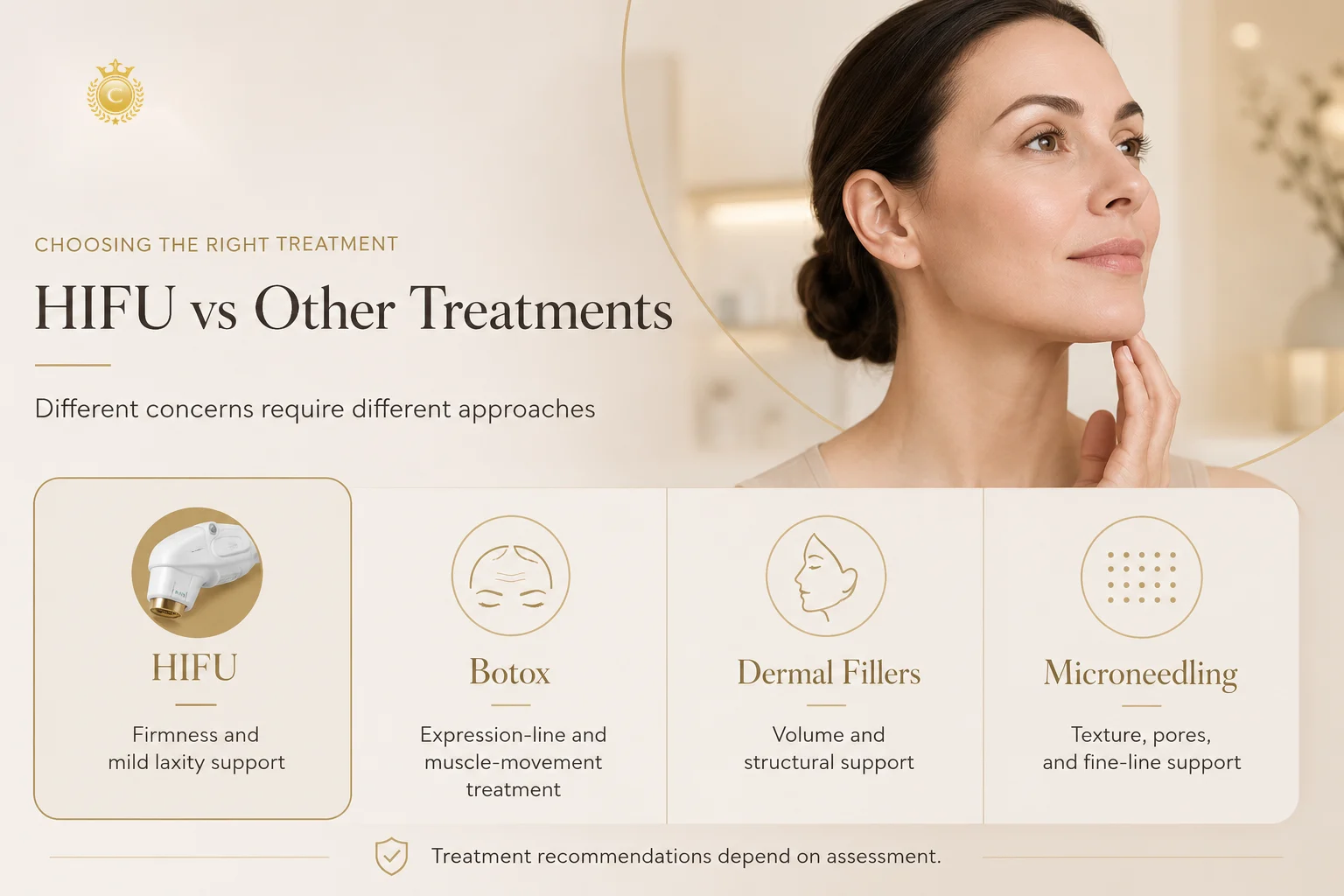
HIFU Compared with Botox, Dermal Fillers, Microneedling, and PRP Facial
Different aesthetic treatments address different concerns. Choosing the right treatment begins with understanding what is causing the change you want to improve.
HIFU vs Botox / Wrinkle Relaxing
Botox and wrinkle-relaxing treatments temporarily reduce movement in selected muscles. They are commonly used for expression lines, such as frown lines or forehead lines.
HIFU does not relax muscles. It focuses on supporting skin firmness in selected areas where mild laxity is the main concern.
HIFU vs Dermal Fillers
Dermal fillers add structural support or restore the appearance of volume in areas such as the cheeks, chin, lips, or jawline.
HIFU does not add volume. It may be considered when reduced skin firmness is the concern rather than volume loss. Some clients may have both laxity and volume loss, which should be assessed separately.
HIFU vs Microneedling
Microneedling creates controlled micro-channels closer to the skin’s surface and is commonly considered for texture, visible pores, fine lines, and post-acne marks.
HIFU focuses on selected deeper layers beneath the skin and is considered for firmness and mild laxity. It should not be presented as a texture or pore treatment.
HIFU vs PRP Facial
PRP Facial uses platelet-rich plasma prepared from the client’s own blood to support facial skin quality and renewal.
HIFU does not use plasma or injectable products. Its focus is non-surgical firmness support rather than radiance, facial texture, or platelet-rich plasma treatment.
Concerns HIFU May Help Support
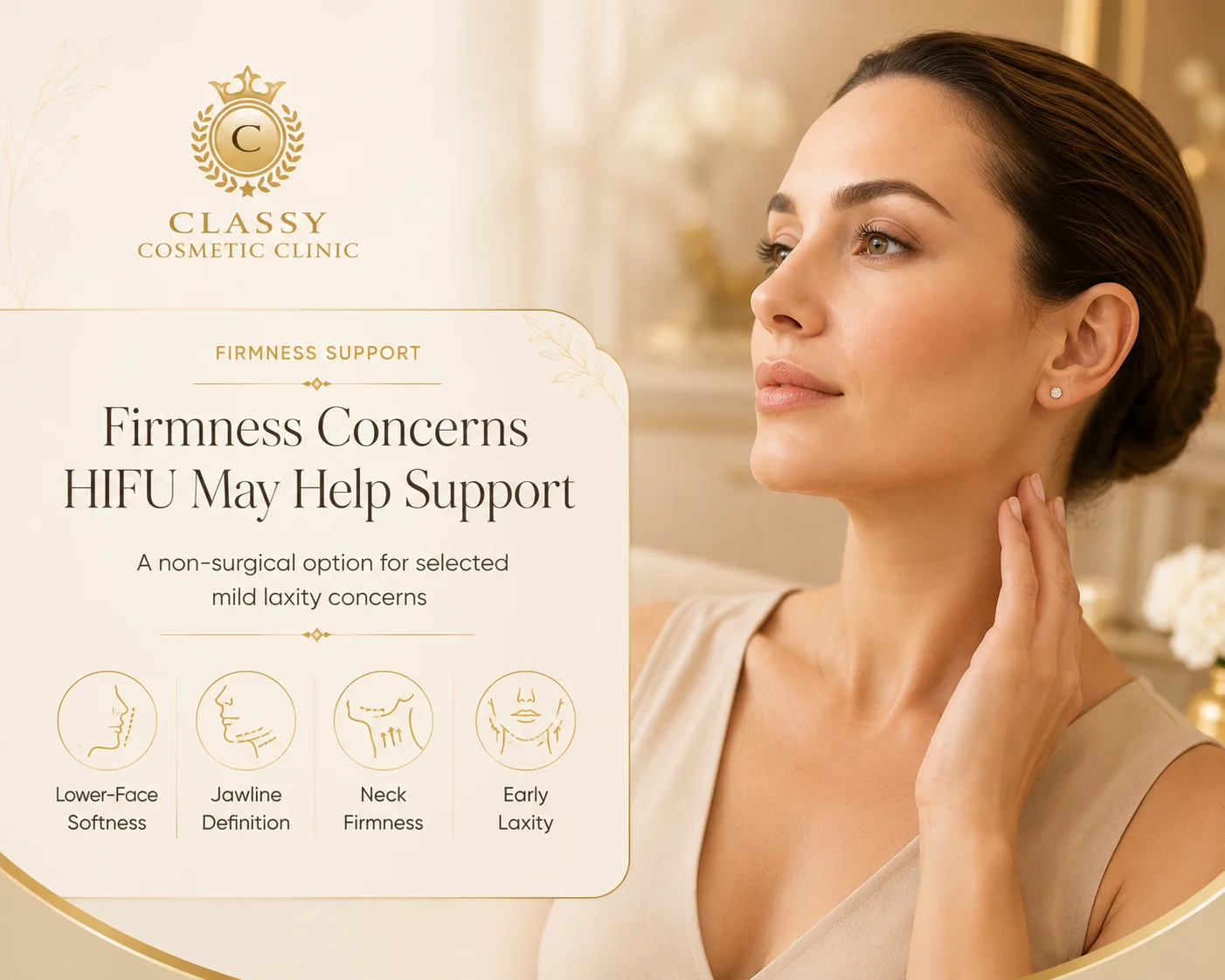
HIFU may be considered for selected firmness concerns when the degree of laxity is mild to moderate.
Mild Skin Laxity
Skin may begin to feel less firm or appear slightly looser over time. HIFU may help support a firmer-looking appearance in suitable clients.
Lower-Face Softness
Changes around the lower face can make the facial outline appear softer. HIFU may help improve the appearance of support in this area, depending on anatomy and assessment.
Jawline Definition Support
When skin laxity contributes to a less defined jawline, HIFU may be considered to support a more refined-looking lower-face outline. It does not promise a sculpted or sharply defined jawline.
Neck Firmness
Mild laxity in the neck may make the area appear less firm. HIFU may help support the appearance of neck firmness in selected clients.
Early Sagging Appearance
Clients noticing early changes in facial support may consider HIFU as a non-surgical option. It is not intended to correct advanced or severe sagging.
Overall Facial Firmness
Some clients are less concerned about one specific feature and more interested in improving the overall appearance of firmness. HIFU may be considered when the skin condition and degree of laxity are appropriate.
Common HIFU Treatment Areas
The areas considered for HIFU depend on the client’s anatomy, concern, device protocol, and assessment.
Lower Face | The lower face may be treated when mild laxity contributes to a softer-looking facial outline. The goal is subtle support rather than dramatic reshaping. |
Jawline | Selected treatment along the jawline may help improve the appearance of skin firmness. Results vary, and HIFU should not be described as guaranteed jawline sculpting. |
Cheeks | HIFU may be considered for selected cheek concerns when firmness, rather than volume loss, is the main issue. Careful assessment is important because some clients may benefit more from other treatments. |
Under-Chin Area | This page focuses on skin-firmness support. If under-chin fullness is the main concern, a separate assessment may be needed to determine whether the concern is related to skin laxity, localized fullness, or a combination of factors. |
Neck | HIFU may be considered for selected clients concerned about mild neck laxity. Suitability depends on skin thickness, anatomy, and the extent of the concern. |
Brow Area | The brow area may be considered only when appropriate and when supported by the clinic’s device protocol. Because this area requires careful treatment planning, suitability must be confirmed during consultation. |
Who May Be a Suitable Candidate
HIFU may be suitable for adults who:
- Have mild to moderate skin laxity
- Want to support firmness in the lower face, jawline, or neck
- Prefer a non-surgical treatment approach
- Understand that changes are gradual and results vary
- Have realistic expectations about the degree of improvement
- Are willing to attend follow-up assessment
- Do not have active skin concerns or medical contraindications in the treatment area
Suitability is not determined by age alone. Skin thickness, anatomy, facial volume, the degree of laxity, and overall health all affect whether HIFU is appropriate.
Some clients may be better suited for dermal fillers, Sculptra, Radiesse, microneedling, or another treatment. Others may need surgical assessment if the laxity is more advanced.
Who May Not Be Suitable
HIFU may not be appropriate if you:
- Have advanced or severe skin laxity
- Expect surgical-level lifting
- Have an active infection, open wound, or significant skin irritation in the treatment area
- Are pregnant or breastfeeding
- Have certain medical devices, implants, or health conditions that affect treatment suitability
- Have experienced significant facial volume loss that may require a different approach
- Have medical or healing concerns that require physician review
- Expect immediate or guaranteed lifting
Your medical history, previous treatments, and current skin condition will be reviewed before treatment. If HIFU is not suitable, another option may be discussed.
Why Assessment Matters Before HIFU
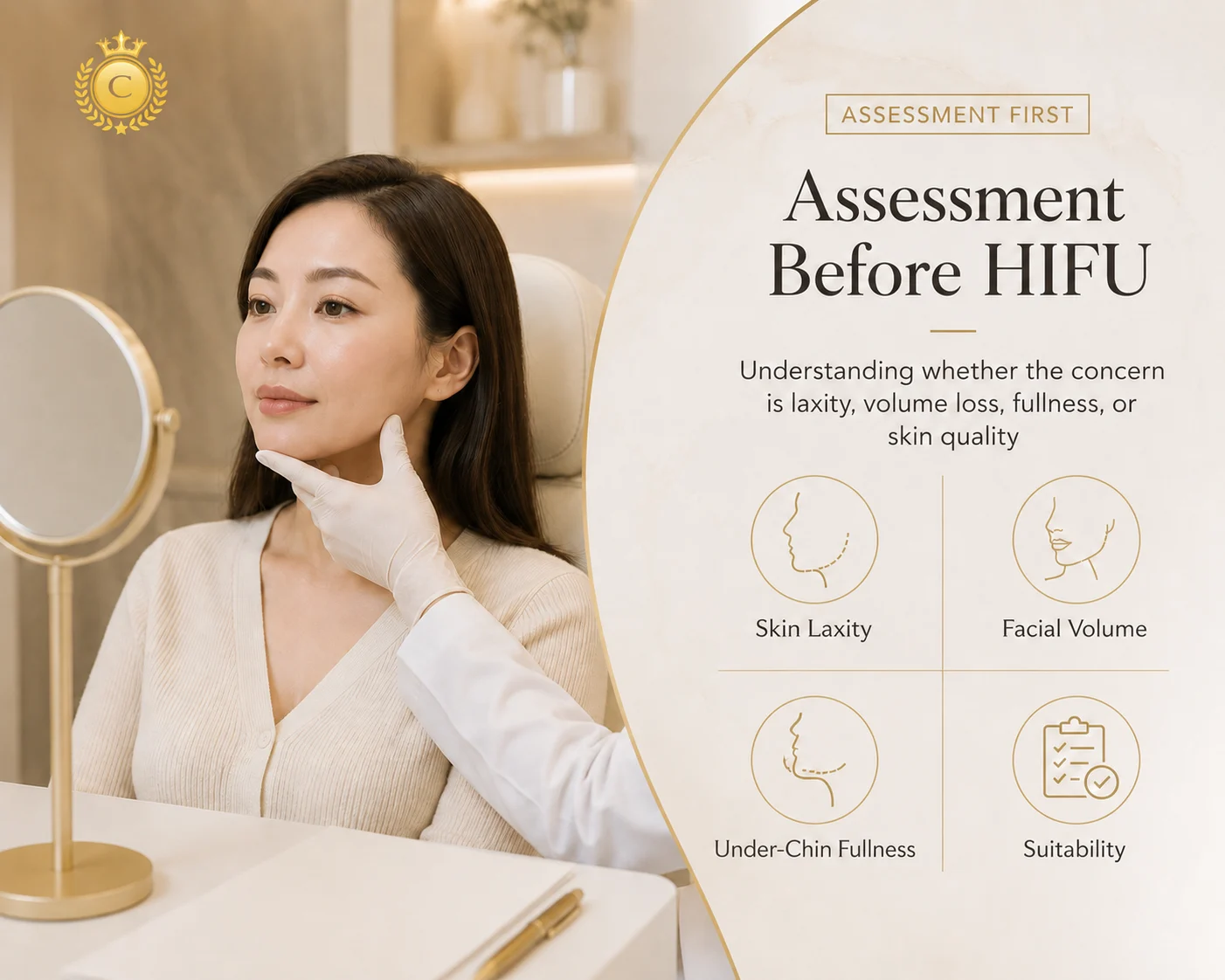
Skin laxity is not always the only reason a face or neck appears less defined. Volume loss, localized fullness, skin quality, muscle movement, and facial structure can all influence appearance.
Before recommending HIFU, we assess:
- The degree and location of skin laxity
- Skin thickness and condition
- Facial volume and structural support
- Under-chin firmness or fullness concerns
- Jawline and neck anatomy
- Previous aesthetic treatments
- Medical history and contraindications
- Your goals and expectations
This assessment helps determine whether HIFU is suitable and which areas should be considered.
For example, if volume loss is the main concern, dermal fillers, Sculptra, or Radiesse may be more appropriate. If expression lines are the concern, Botox / Wrinkle Relaxing may be considered. If texture and pores are the main concern, microneedling may be more relevant.
The goal is to recommend the treatment that best matches the concern, rather than applying HIFU to every client seeking facial improvement.
The HIFU Treatment Process
1. Consultation
Your appointment begins with a consultation at Classy Cosmetic Clinic in Thornhill or Newmarket. We discuss your concerns, review your medical history, assess your skin, and explain what HIFU may and may not help improve. You will have the opportunity to ask questions and understand the expected treatment experience before deciding whether to proceed.
2. Skin Assessment
The provider assesses the treatment area, degree of laxity, skin quality, and facial anatomy. This helps determine whether HIFU is appropriate and which areas may be considered.
3. Treatment Mapping
If treatment is suitable, the selected areas are mapped carefully. Treatment mapping helps guide placement and supports a consistent approach based on your anatomy and the clinic’s device protocol.
4. Ultrasound Energy Delivery
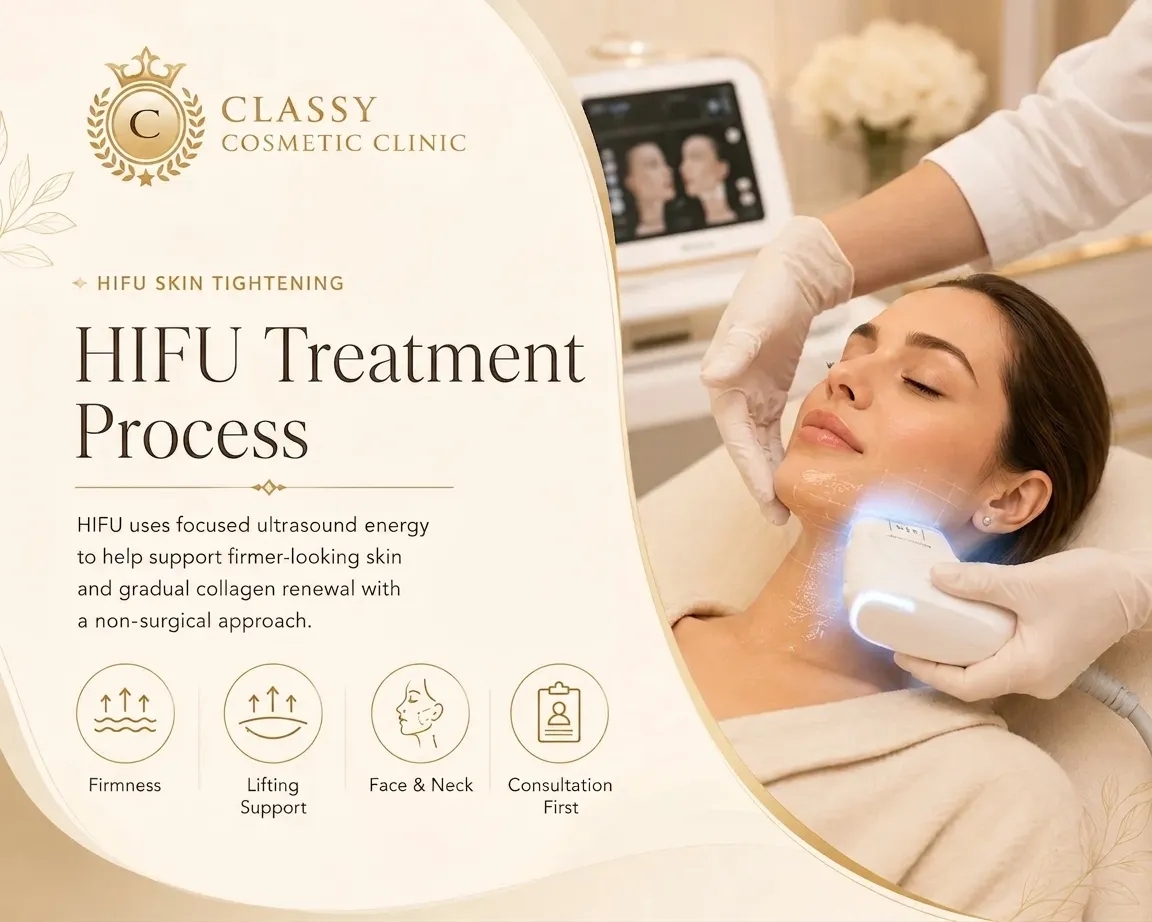
A treatment gel is applied, and the HIFU handpiece is placed against the skin. Focused ultrasound energy is delivered beneath the skin’s surface at selected treatment depths. During treatment, you may feel warmth, tingling, pressure, or brief sensitivity. The sensation varies by treatment area, device settings, and individual sensitivity. Treatment time varies depending on the number and size of the areas being treated.
5. Aftercare Guidance
After treatment, your provider will explain what to expect and how to care for the area. Aftercare guidance varies depending on treatment area, device protocol, and individual response. You may be advised to use gentle skincare and avoid activities or products that could irritate the treated area for a short period.
6. Follow-Up and Maintenance
A follow-up appointment may be recommended to assess your response. Additional or maintenance treatment may be discussed after follow-up assessment. Treatment frequency should be based on your skin condition and response, not a fixed schedule.
What to Expect During and After Treatment
During HIFU treatment, you may feel warmth, pressure, tingling, or brief sensitivity as the device delivers ultrasound energy. Some areas may feel more sensitive than others.
After treatment, some clients experience temporary redness, tenderness, swelling, sensitivity, or altered sensation in the treated area. These effects vary by person and treatment protocol.
Many clients return to their usual routine shortly after treatment, but recovery experience differs. Your provider will explain what is expected based on the areas treated and your individual response.
Contact the clinic if you experience unexpected, persistent, or concerning symptoms after treatment.
Results Timeline and Realistic Expectations
HIFU is not intended to create an immediate or dramatic lift. Visible changes may develop gradually over several weeks to months, and timing and longevity vary.
Some clients notice a subtle feeling of firmness earlier, while others see changes more slowly. The final appearance depends on several factors, including:
- Baseline skin condition
- Degree of laxity
- Age and collagen response
- Facial anatomy
- Lifestyle and sun exposure
- Treatment area
- Individual healing response
Results may be subtle. HIFU does not replace facelift surgery and is not intended to correct severe skin laxity.
A follow-up assessment is important before deciding whether additional treatment is appropriate.
How Many Sessions May Be Needed
The number of HIFU sessions varies.
Some clients may begin with one treatment and review their response over time. Others may discuss additional treatment after follow-up assessment.
The appropriate number of sessions depends on:
- The degree of laxity
- Treatment area
- Skin quality
- Individual response
- Device protocol
- Treatment goals
Additional or maintenance treatment may be discussed after follow-up assessment. HIFU should not be repeated automatically without reviewing the skin’s response and ongoing suitability.
Maintenance and Follow-Up
HIFU results are not permanent, and natural changes in the skin continue over time.
Follow-up appointments allow the provider to assess firmness, review your goals, and discuss whether maintenance or another treatment may be appropriate.
- Supportive care may include:
- Consistent sun protection
- Gentle, appropriate skincare
- Avoiding unnecessary over-treatment
- Maintaining overall health and hydration
- Reviewing changes in facial volume or skin quality over time
Other services may be discussed when they address a different concern. Dermal fillers may be considered for volume loss. Microneedling may be more relevant for texture. Sculptra or Radiesse may be discussed for selected collagen-support or structural concerns.
Any combined approach should be planned carefully and based on assessment.
HIFU Skin Tightening in Thornhill and Newmarket
Classy Cosmetic Clinic offers HIFU Skin Tightening consultations and treatments at both our Thornhill and Newmarket locations.
Our Thornhill clinic serves clients from Thornhill, North York, Richmond Hill, Vaughan, Markham, and nearby communities. Our Newmarket location is convenient for clients from Newmarket, Aurora, East Gwillimbury, Bradford, and surrounding York Region areas.
Clients seeking HIFU treatment in Thornhill or Newmarket often want support for mild facial or neck laxity without surgery. At Classy Cosmetic Clinic, treatment begins with a careful assessment to determine whether HIFU is suitable for the concern.
Whether you are considering skin tightening for the face and neck in Thornhill or Newmarket, our approach remains calm, professional, and consultation-based.
Why Choose a Consultation-First Approach at Classy Cosmetic Clinic
HIFU should not be recommended simply because a client wants a firmer appearance. The first step is understanding whether laxity is truly the concern and whether ultrasound-based treatment is appropriate.
At Classy Cosmetic Clinic, we focus on careful assessment, honest recommendations, and realistic expectations.
Our approach includes:
- Reviewing your skin condition and facial anatomy
- Identifying whether the concern is laxity, volume loss, fullness, or texture
- Explaining what HIFU may and may not help improve
- Avoiding aggressive or unnecessary treatment
- Reviewing possible side effects and aftercare
- Planning follow-up based on your response
We provide medically mindful aesthetic care in a professional clinical setting. The goal is to support subtle improvement while respecting your natural features and individual treatment suitability.

Faq
1. What is HIFU Skin Tightening?
HIFU uses focused ultrasound energy delivered beneath the skin’s surface at selected treatment depths. It may help support collagen remodeling and firmer-looking skin over time.
2. Is HIFU the same as a facelift?
No. HIFU is a non-surgical treatment for selected firmness concerns. It does not create the same degree of correction as facelift surgery and is not suitable for severe laxity.
3. How is HIFU different from Botox?
Botox / Wrinkle Relaxing reduces movement in selected muscles to soften expression lines. HIFU does not relax muscles; it focuses on skin-firmness support.
4. How is HIFU different from dermal fillers?
Dermal fillers add volume or structural support. HIFU does not add volume. It may be considered when mild skin laxity is the primary concern.
5. Is HIFU the same as microneedling?
No. Microneedling focuses on texture, pores, and post-acne marks by creating controlled micro-channels. HIFU delivers focused ultrasound energy beneath the skin for firmness support.
6. Who may be suitable for HIFU?
HIFU may be suitable for adults with mild to moderate skin laxity who want a non-surgical approach. Suitability depends on assessment.
7. When may I notice changes?
Visible changes may develop gradually over several weeks to months. Timing and degree of improvement vary by individual.
8. How many sessions will I need?
The number of sessions varies. Additional or maintenance treatment may be discussed after follow-up assessment.
9. What does HIFU feel like?
You may feel warmth, tingling, pressure, or brief sensitivity during treatment. The sensation varies by area, settings, and individual sensitivity.
10. Is there downtime after HIFU?
Many clients return to their regular routine shortly after treatment, but temporary redness, tenderness, swelling, or sensitivity may occur. Recovery varies.
11. Can HIFU help under-chin concerns?
This page focuses on skin-firmness support. If under-chin fullness is the main concern, a separate assessment may be needed to determine the most appropriate treatment approach.
12. Can HIFU be combined with other treatments?
HIFU may be included in a broader treatment plan when appropriate. Botox, dermal fillers, microneedling, Sculptra, or Radiesse address different concerns and should be planned separately after assessment.
Ready to Discuss HIFU Skin Tightening?
If you are noticing mild changes in facial or neck firmness and want to explore a non-surgical option, a consultation can help determine whether HIFU may be suitable.
Classy Cosmetic Clinic provides HIFU Skin Tightening consultations in both Thornhill and Newmarket with a careful, assessment-first approach.
- Thornhill: 7163 Yonge Street Suite 269, Thornhill, Ontario L3T 0C6
- Newmarket: 16775 Yonge Street Suite 217, Newmarket, Ontario L3Y 8J


