
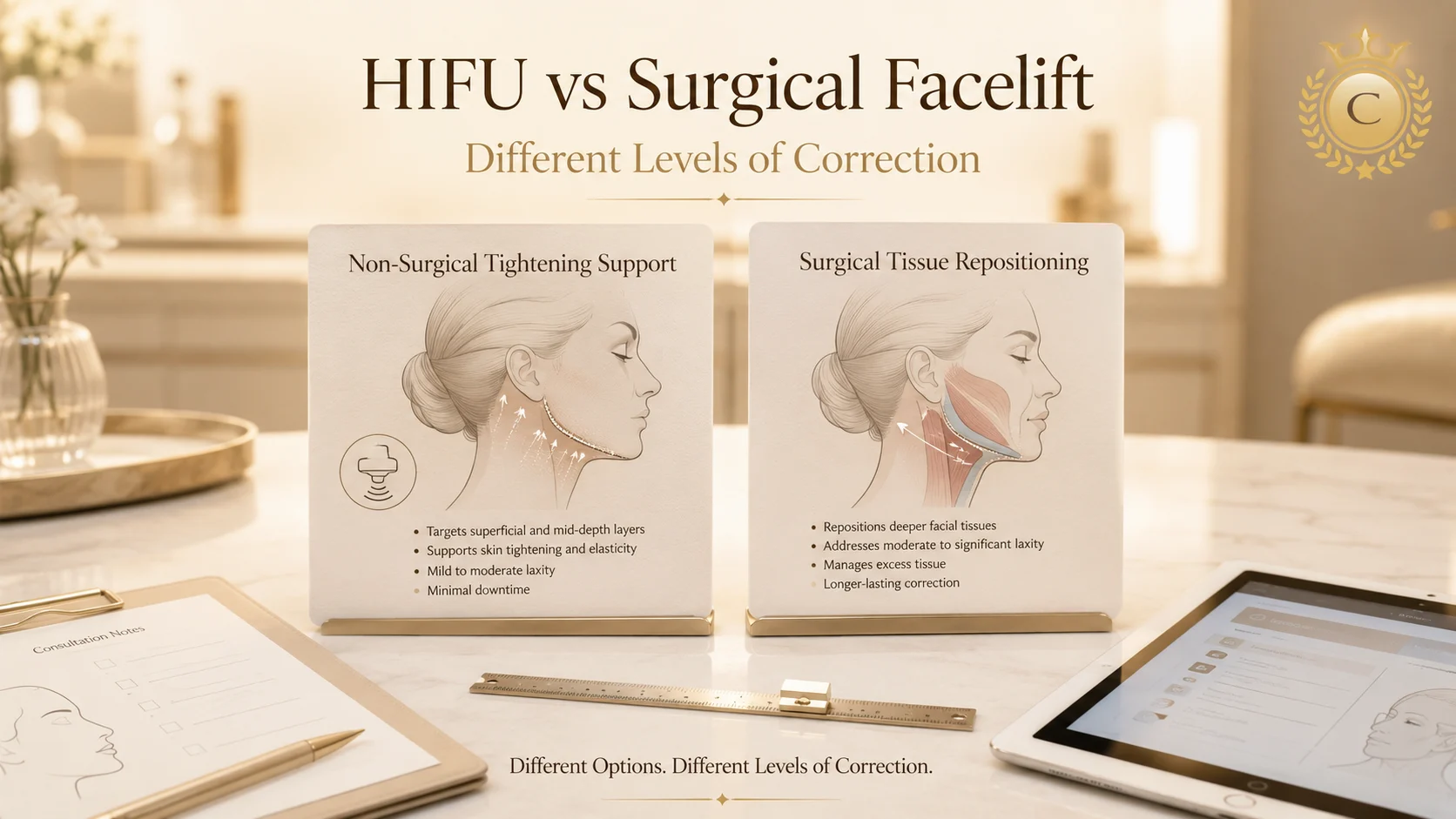
People often compare HIFU with facelift surgery because both may be discussed when the lower face, jawline, or neck begins to look less firm. However, they are not equivalent treatments and should not be expected to produce the same level of correction. HIFU may be suitable for mild to moderate skin laxity and subtle tightening support, while surgical facelift procedures are usually considered for more significant skin laxity, tissue repositioning, or more dramatic correction. A consultation is needed to determine suitability. At Classy Cosmetic Clinic, HIFU is approached as a non-surgical skin tightening option for selected clients in Thornhill and Newmarket. It is not presented as a substitute for surgical correction, and treatment recommendations depend on anatomy, skin quality, degree of laxity, goals, and realistic expectations.
Quick Answer: HIFU uses focused ultrasound energy to support collagen-related tightening at selected tissue depths. It may help clients with mild or moderate laxity who want gradual, subtle improvement without surgery.
A surgical facelift is a more invasive procedure that can reposition deeper tissues and remove excess skin. It is generally more appropriate when sagging, jowling, or loose skin is significant.
Educational Disclaimer: This article is educational and does not replace consultation with a qualified provider. Treatment suitability depends on assessment, anatomy, skin quality, medical history, goals, and expectations.
Definition Box
| Term | Clear Explanation |
|---|---|
| HIFU | High-Intensity Focused Ultrasound is a non-surgical treatment that delivers focused ultrasound energy beneath the skin to support collagen-related firmness and gradual tightening in selected clients. |
| Surgical facelift | A surgical procedure that may reposition deeper facial tissues and remove or adjust excess skin. The exact technique and suitability must be discussed with a qualified surgeon. |
| Non-surgical skin tightening | Treatments that aim to support firmness or subtle lifting without incisions or surgical tissue repositioning. Results are generally more modest than surgery. |
| Skin laxity | Looseness or reduced firmness of the skin and supporting tissues. It may range from mild softening to more significant sagging. |
| Collagen support | A treatment goal involving stimulation or support of collagen-related tissue firmness over time. It does not mean complete collagen replacement. |
| Realistic expectations | Understanding that HIFU may provide gradual, subtle tightening support but cannot reproduce the level of tissue repositioning possible with surgery. |
Why People Compare HIFU and Facelift Surgery
The comparison usually begins with a shared concern: the face or neck no longer looks as firm as before. A person may notice:
- A softer jawline
- Early jowling
- Mild looseness beneath the chin
- Reduced firmness in the lower face
- Early neck laxity
- Changes in facial definition
- Skin that feels less supported
These concerns may lead someone to search for a “non-surgical facelift.” That phrase can be misleading if it suggests that a non-surgical treatment can create the same correction as surgery. HIFU and facelift surgery work at different levels and have different limitations. HIFU may support gradual firmness in selected tissue layers. Surgery can physically reposition deeper tissues and manage excess skin more directly. The decision is not simply between a “small treatment” and a “strong treatment.” It is about identifying the cause and degree of the concern.
Tightening Support Is Not the Same as Surgical Repositioning
This is the central distinction. HIFU is intended to support skin firmness and subtle lifting through focused energy and the body’s gradual tissue response. It does not remove excess skin. It does not surgically reposition facial tissues. It does not create immediate structural correction. A surgical facelift may address:
- More significant lower-face sagging
- Pronounced jowling
- Loose facial or neck skin
- Deeper tissue descent
- Concerns requiring physical tissue repositioning
HIFU may be discussed for:
- Mild jawline softening
- Early neck looseness
- Mild to moderate skin laxity
- Clients who prefer a non-surgical option
- Clients comfortable with gradual and subtle change
- Maintenance-oriented treatment planning
One should not be marketed as equivalent to the other.
What HIFU Is Intended to Do
HIFU stands for High-Intensity Focused Ultrasound. The treatment delivers focused ultrasound energy at selected depths beneath the skin. The aim is to create controlled thermal points that may support the body’s collagen-related repair response. Over time, this may help improve the appearance of firmness and provide subtle tightening support. HIFU is not a volume treatment. It does not work like dermal fillers. It does not add gel beneath the skin, directly reshape the jawline, or replace lost facial volume. It may be considered when the concern is primarily:
- Mild laxity
- Early softening
- Reduced firmness
- Subtle jawline definition changes
- Early neck looseness
- Gradual maintenance
Changes tend to develop over time rather than appearing as an instant lift.
What a Surgical Facelift Is Intended to Do
A surgical facelift is an operative procedure. Depending on the technique, it may involve repositioning deeper tissues, managing excess skin, and improving more significant sagging in the lower face or neck. Surgery may be more appropriate when the concern includes:
- Significant jowling
- Moderate to severe facial sagging
- Considerable neck laxity
- Loose skin after major weight change
- A desire for more substantial correction
- Tissue changes that cannot be meaningfully addressed through non-surgical tightening alone
Surgical procedures involve anesthesia, incisions, recovery, surgical risk, and evaluation by a qualified surgeon. A person seeking surgery-level correction should not be encouraged to expect the same result from HIFU.
HIFU vs Surgical Facelift
| Feature | HIFU | Surgical Facelift |
|---|---|---|
| Treatment type | Energy-based, non-surgical treatment | Surgical procedure |
| Invasiveness | No surgical incisions | Incisions and operative intervention |
| Typical goal | Subtle tightening and firmness support | Tissue repositioning and more significant correction |
| Skin laxity level | Generally mild to moderate | Often moderate to severe |
| Recovery | Often shorter than surgery, although temporary redness, tenderness, swelling, or sensitivity may occur | More significant recovery and surgical aftercare |
| Result intensity | Gradual and subtle | More substantial, depending on procedure |
| Maintenance | May be discussed over time | Results still change with aging; future maintenance varies |
| Suitability | Selected clients seeking non-surgical support | Clients whose concerns require surgical correction |
| Removes excess skin | No | May, depending on surgical technique |
| Consultation need | Essential | Essential with a qualified surgeon |
When HIFU May Be Suitable
HIFU may be discussed when a client has mild or moderate laxity and understands that the expected change is subtle. Possible candidates may include adults who:
- Notice early lower-face softening
- Have mild jawline laxity
- See early looseness beneath the chin
- Have mild neck laxity
- Prefer a non-surgical treatment
- Are comfortable with gradual improvement
- Understand that results vary
- Do not expect surgery-level lifting
- Have realistic goals
- Are medically suitable after assessment
HIFU may also be considered as part of a broader maintenance plan for clients who are not ready for surgery or do not currently require surgical correction. Suitability still depends on anatomy, tissue thickness, skin quality, facial volume, and the location of the concern.
When HIFU May Not Be Enough
HIFU has limitations. It may not provide enough correction when there is:
- Significant sagging
- Pronounced jowling
- Considerable excess skin
- Severe neck laxity
- Major tissue descent
- Loose skin after substantial weight loss
- A desire for dramatic change
- An expectation of surgical-level lifting
In these cases, a surgical consultation may be more appropriate. It is also possible that a client’s concern is not primarily laxity. A softer face may be caused by volume loss, localized fat, skeletal structure, surface-level skin concerns, or a combination. HIFU cannot replace lost cheek volume, improve chin projection, dissolve localized fat, correct pigmentation, or resurface acne-related texture. That is why careful assessment of the concern matters before selecting treatment.
Which Concern May Fit Which Option?
| Concern | HIFU May Be Discussed When | Surgical Consultation May Be More Appropriate When |
|---|---|---|
| Mild jawline laxity | The jawline looks slightly softer and expectations are subtle | There is pronounced jowling or deeper tissue descent |
| Early neck looseness | Skin laxity is mild and excess skin is limited | Loose neck skin is significant |
| Subtle lower-face softening | The concern is early and gradual tightening is acceptable | The client wants major structural correction |
| Moderate to severe sagging | HIFU may be unlikely to meet the goal; expectations must remain very conservative | A surgical opinion may be more appropriate when meaningful tissue repositioning is required |
| Significant jowling | HIFU is unlikely to replicate surgical correction | A facelift or lower-face surgical consultation may be more appropriate |
| Loose skin after major weight loss | Non-surgical treatment may provide limited support | Excess skin may require surgical management |
| Desire for dramatic correction | HIFU is not suited to dramatic expectations | Surgical options may better match the goal |
| Preference to avoid surgery | HIFU may be considered if laxity is mild enough | Avoiding surgery does not make HIFU equivalent if correction needs are substantial |
Common Areas People Ask About
Jawline
Jawline skin tightening is one of the most common HIFU questions. HIFU may be discussed when early laxity is making the jawline look softer. However, jawline definition is influenced by more than skin tightness. Chin projection, bone structure, facial fat, localized under-chin fullness, and volume loss can all affect the jawline. Some clients may be better suited to dermal fillers, fat dissolving treatment, or a combination plan after assessment.
Lower Face
HIFU may support subtle firmness in the lower face when laxity is mild or moderate. It cannot reposition deeper tissues in the same way as a surgical facelift.
Under the Chin
Fullness beneath the chin may be caused by localized fat, loose skin, anatomy, or a combination. HIFU is more relevant when laxity is part of the concern. If localized fat is the main issue, another treatment category may be discussed.
Neck
Neck skin tightening may be considered for selected clients with early looseness. Significant neck laxity or excess skin may need surgical evaluation.
Brow or Selected Upper-Face Areas
Selected upper-face areas may be considered only when they are included in the clinic’s device protocol and judged appropriate after assessment. Expectations should remain conservative, and treatment should not be described as a surgical brow lift.
Realistic Expectations for HIFU
| Expectation | More Realistic Framing |
|---|---|
| “I want subtle tightening support.” | This may align with HIFU if laxity is mild or moderate and anatomy is suitable. |
| “I want surgery-like lifting.” | HIFU cannot reproduce surgical tissue repositioning. |
| “I have mild skin laxity.” | HIFU may be discussed after assessment. |
| “I have significant sagging.” | HIFU may not provide enough correction; surgical consultation may be more appropriate. |
| “I want no maintenance.” | Non-surgical results may require future reassessment or maintenance. |
| “I want to improve skin firmness gradually.” | This is a more realistic HIFU goal. |
| “I want an instant result.” | HIFU changes are generally gradual. |
| “I want my jawline completely reshaped.” | Jawline shape may involve bone structure, volume, fat, and skin—not laxity alone. |
What Results and Timing Can People Expect?
HIFU results develop gradually. Some clients may notice early subtle changes over the following weeks, with further change developing gradually over the following months as tissue response progresses. The degree of change depends on:
- Starting skin laxity
- Age and skin quality
- Anatomy
- Treatment depth and area
- Individual tissue response
- Lifestyle
- Treatment history
- Expectations
Not everyone responds in the same way. Results are not guaranteed. HIFU should not be scheduled with the expectation of immediate transformation before an event. It is better suited to clients who are comfortable with gradual-looking change.
Recovery and Comfort
The recovery experience varies. Some clients may experience temporary:
- Redness
- Tenderness
- Warmth
- Sensitivity
- Mild swelling
- Tingling
- Temporary discomfort
HIFU should not be described as painless or as having guaranteed zero downtime. Many clients continue normal activities, but individual response varies. A provider should explain expected comfort, aftercare, and when to contact the clinic before treatment.
Can HIFU Be Combined With Other Treatments?
Sometimes. HIFU may be one part of a broader facial rejuvenation plan when the client has more than one type of concern. Examples may include:
- HIFU for mild laxity
- Dermal fillers for selected volume loss or contour support
- Sculptra for gradual collagen and facial structure support
- Radiesse for selected firmness or structural goals
- Skin boosters for hydration and skin quality
- Fat dissolving treatment for localized under-chin fullness
Combination treatment should not be automatic. These options address different concerns, and they may need to be staged rather than performed at the same appointment. Sequencing and intervals should be determined after assessment. A consultation helps determine whether the concern is laxity, volume loss, localized fat, skin quality, or a combination.
Why Consultation Matters More Than the Treatment Name
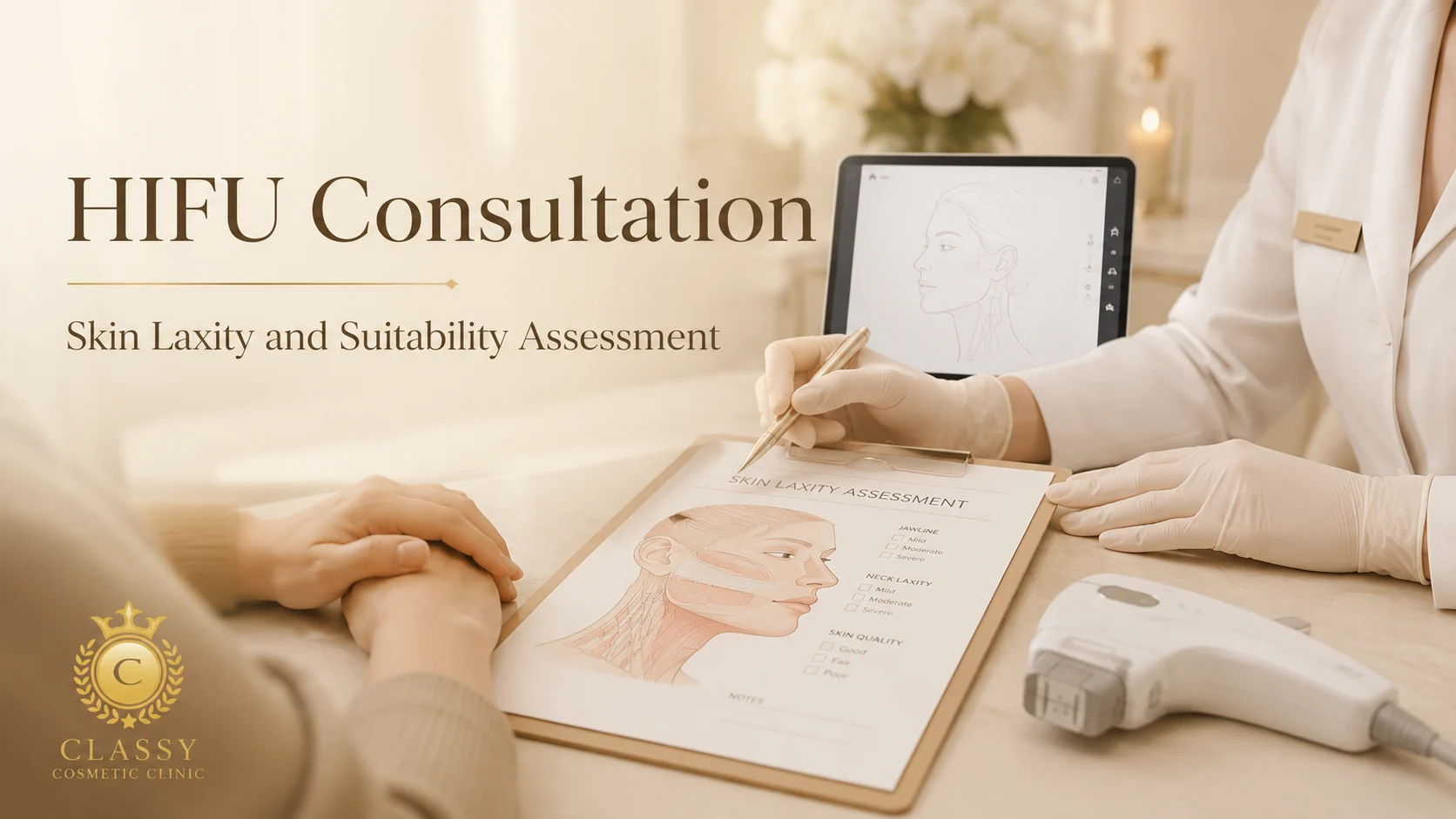
Many clients arrive asking for HIFU because they want to avoid surgery. That preference is understandable, but treatment choice must still be based on what the anatomy requires. During a consultation, the provider may assess:
- Degree of skin laxity
- Jawline and neck anatomy
- Facial volume
- Skin thickness
- Localized fat
- Previous treatments
- Medical history
- Desired level of correction
- Willingness to accept gradual change
- Whether expectations are realistic
The provider may recommend HIFU, another non-surgical option, surgical consultation, or no treatment. A responsible recommendation may sometimes be that HIFU is unlikely to meet the client’s goal.
HIFU Treatment in Thornhill & Newmarket
Classy Cosmetic Clinic offers HIFU consultation and treatment planning for suitable clients in Thornhill and Newmarket. The Thornhill clinic serves clients from Thornhill, Richmond Hill, Vaughan, North York, and nearby York Region communities. The Newmarket clinic serves clients from Newmarket, Aurora, East Gwillimbury, Bradford, and surrounding areas. At both locations, the approach is consultation-first. Clients can discuss whether HIFU skin tightening, another collagen-supportive treatment, dermal fillers, or a surgical opinion may better match their anatomy and goals.
Thornhill
7163 Yonge Street Suite 269
Thornhill, Ontario L3T 0C6
Newmarket
16775 Yonge Street Suite 217
Newmarket, Ontario L3Y 8J1
Key Takeaways
- HIFU and surgical facelift procedures are not equivalent.
- HIFU may support subtle tightening for mild to moderate skin laxity.
- Surgery is more appropriate when significant tissue repositioning or excess-skin correction is needed.
- HIFU does not remove excess skin.
- HIFU cannot guarantee lifting or surgery-like results.
- Jawline and neck concerns may involve laxity, fat, volume, anatomy, or several factors.
- Results develop gradually and vary between clients.
- HIFU may be combined with other treatments when concerns are different.
- Consultation is necessary to determine whether HIFU is likely to meet the client’s goals.
- A surgical consultation may be the more honest recommendation for significant sagging.
Frequently Asked Questions
Is HIFU the same as a facelift?
Can HIFU replace surgery?
Who is HIFU suitable for?
Is HIFU better for mild or severe skin laxity?
What areas can HIFU be discussed for?
How soon do people see changes?
Are HIFU results guaranteed?
Is consultation needed before HIFU?
Can HIFU be combined with other treatments?
Is HIFU available in Thornhill and Newmarket?
Considering HIFU in Thornhill or Newmarket?
If you are considering HIFU in Thornhill or Newmarket, book a consultation to understand whether non-surgical skin tightening may be suitable for your skin, anatomy, and goals.