

Acne scars can remain long after breakouts have settled. For some people, the concern is uneven texture. For others, it may be small depressions, shadowing, enlarged-looking pores, or areas where the skin no longer looks as smooth as it once did.
Acne scar treatment is not one-size-fits-all. The right approach depends on the type of scar, skin tone, active acne status, skin sensitivity, treatment history, and how much downtime is realistic for you.
At Classy Cosmetic Clinic in Thornhill and Newmarket, acne scar treatment begins with consultation. The goal is to understand what kind of acne scars you have before discussing options such as microneedling, PRP Facial, skin boosters, or other skin rejuvenation treatments.
Quick Answer
Acne scar treatment may help improve the appearance of certain acne scars and uneven skin texture, but results vary. Microneedling may support collagen remodeling for selected texture concerns, while PRP Facial may support overall skin quality and gradual renewal. Some acne scars may need a combination approach, and deeper or complex scars may require referral or a different treatment plan.
Consultation is recommended before choosing a treatment.
Why Acne Scars Develop
Acne scars usually form when inflammation affects deeper layers of the skin. When the skin tries to heal after inflamed acne, collagen production may become uneven. Too little collagen can lead to depressed or pitted scars. Too much collagen can create raised or thickened scars.
The risk of scarring can be influenced by:
- Deep inflammatory acne
- Cystic acne
- Picking or squeezing breakouts
- Delayed acne treatment
- Genetics
- Skin tone and pigmentation response
- Repeated inflammation in the same area
- Healing patterns
It is also important to separate acne scars from post-acne marks. Brown or red marks after acne are not always true scars. They may be post-inflammatory pigmentation or redness, which require a different approach than depressed texture scars.
Good to Know
Not every mark left after acne is a scar. Some marks are pigment or redness, while true acne scars usually involve a change in skin texture or contour.
Different Types of Acne Scars
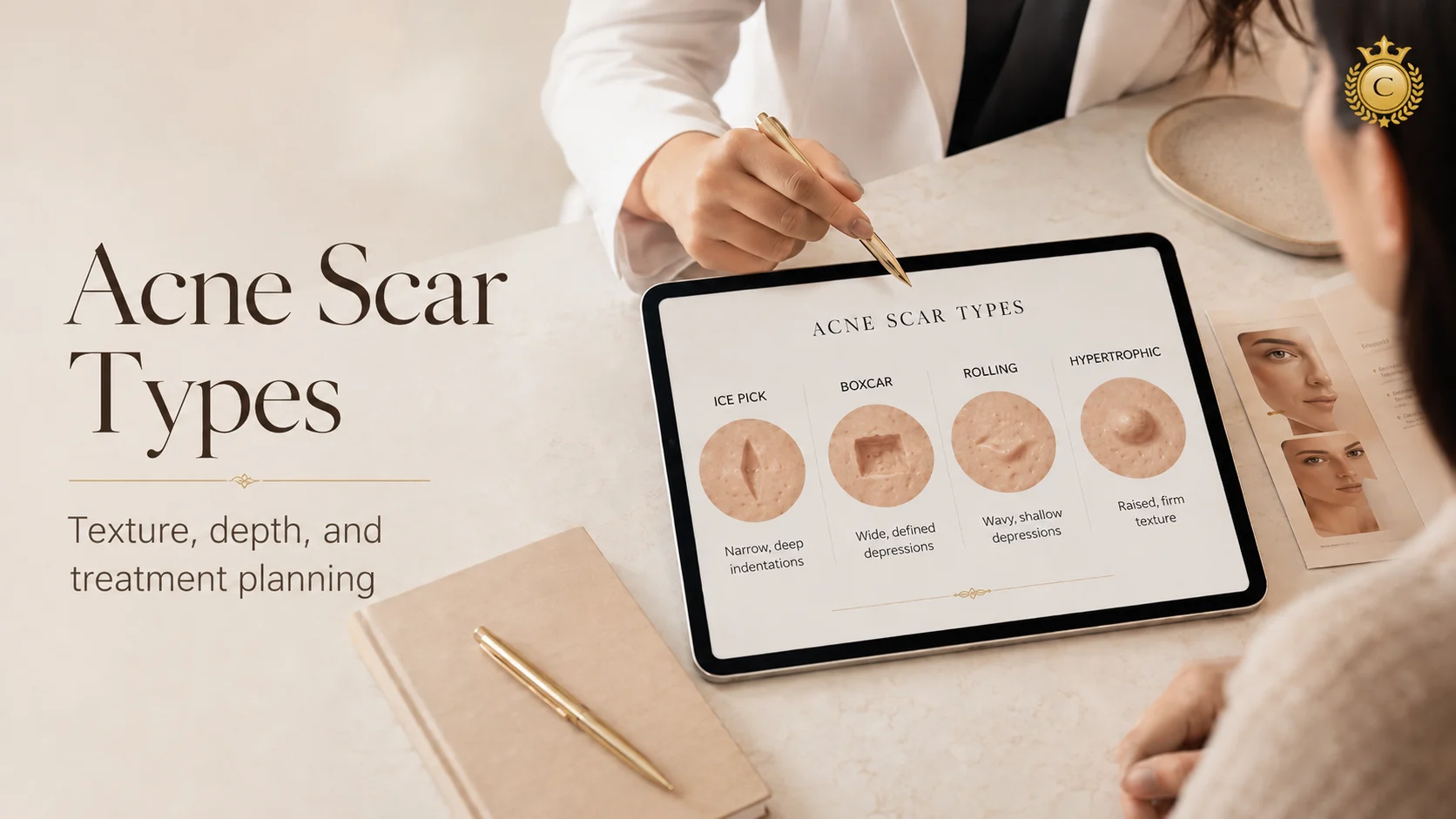
Understanding scar type helps guide treatment planning.
Ice Pick Scars
Ice pick scars are narrow, deep scars that look like tiny punctures in the skin. Because they are deep and sharply defined, they may not respond as well to surface-level treatments alone.
Boxcar Scars
Boxcar scars are wider depressions with more defined edges. They can be shallow or deeper. Some may respond to collagen-supporting treatments, while others may need more targeted approaches.
Rolling Scars
Rolling scars create a wave-like texture on the skin. They may become more visible in certain lighting because of how shadows fall across the skin.
Hypertrophic or Raised Scars
Raised acne scars form when the skin produces too much collagen during healing. These scars are different from depressed scars and often require a different treatment approach.
Pigmented Marks After Acne
Brown, red, or purple marks after acne may be related to pigmentation or vascular changes rather than textural scarring. These concerns may need skincare, sun protection, chemical exfoliation, or other pigment-focused strategies.
Acne Scar Type vs. Treatment That May Be Discussed
| Acne Scar or Concern | Treatment That May Be Discussed |
|---|---|
| Mild rolling texture | Microneedling, PRP Facial, or combination planning |
| Shallow boxcar scars | Microneedling or staged skin rejuvenation |
| Deep ice pick scars | Referral or targeted scar treatment may be discussed |
| General uneven skin texture | Microneedling or PRP Facial |
| Dullness with mild acne marks | PRP Facial or skin boosters depending on assessment |
| Post-acne pigmentation | Skincare, pigment-focused options, or medical evaluation |
| Active inflamed acne | Acne control first; scar treatment may be delayed |
| Raised or thickened scars | Medical assessment or referral may be more appropriate |
This table is educational only. Treatment recommendations depend on assessment.
Concern and Primary Discussion
| Concern | Primary Discussion |
|---|---|
| Uneven texture | Microneedling |
| Skin quality and freshness | PRP Facial |
| Hydration or smoother-looking skin quality | Skin Boosters or broader skin-quality planning |
| Deep or narrow scars | Additional assessment or referral may be discussed |
| Active acne | Acne control first before scar-focused treatment |
| Pigmentation after acne | Pigment-focused skincare, sun protection, or medical evaluation |
| Volume-related depression | Dermal fillers may be discussed only in selected cases |
This table helps separate scar treatment from active acne care, pigment management, and general skin-quality support. The right direction depends on the skin assessment.
Why One Treatment Does Not Work for Every Scar
Acne scars vary in depth, shape, firmness, and cause. A treatment that may improve shallow texture may not significantly improve deeper ice pick scars. A treatment that supports collagen may not be the right choice for active acne, pigmentation, or raised scars.
This is why acne scar treatment in Thornhill or Newmarket should begin with a skin assessment, not a menu of procedures.
- A good consultation should ask:
- Are the scars depressed, raised, or pigmented?
- Is there active acne?
- Is the skin sensitive or reactive?
- Has the client used isotretinoin or strong acne medication recently?
- What is the client’s skin tone and pigmentation risk?
- How much downtime is acceptable?
- Is gradual improvement acceptable?
- Would a combination approach be more appropriate?
Consultation Tip
Bring photos of your skin during different lighting if your scars appear worse in certain conditions. Acne scars often look different in overhead light, natural light, and close-up mirrors.
Important
Active acne should usually be managed before beginning acne scar treatment. Treating texture while breakouts are still inflamed can increase irritation and may not address the cause of ongoing scarring.
Microneedling for Acne Scars
Microneedling is often discussed for acne scars because it creates controlled micro-channels in the skin. This process may encourage the skin’s natural repair response and support collagen remodeling over time.
For selected clients, microneedling may help improve:
- Uneven skin texture
- Shallow acne scars
- Enlarged-looking pores
- Mild rolling scars
- Overall skin smoothness
- Skin rejuvenation goals
Microneedling is not instant scar removal. Improvement is typically gradual, and a series of sessions may be recommended depending on scar type, skin response, and treatment goals.
At Classy Cosmetic Clinic, microneedling may be discussed when the concern is texture-focused and the skin is suitable for collagen-supportive treatment.
PRP Facial for Acne Scar Support
PRP Facial is a skin-focused treatment that uses platelet-rich plasma prepared from the client’s own blood sample. PRP may support skin quality, texture, tone, and gradual renewal in selected clients.
For acne scar concerns, PRP Facial may be discussed when the goal is broader skin rejuvenation support rather than targeted correction of one deep scar.
PRP Facial may be considered for:
- Overall skin quality
- Dull or tired-looking skin
- Mild texture concerns
- Minor acne-scar texture
- Collagen support
- Freshness and tone support
PRP should not be presented as a guaranteed acne scar removal treatment. It may support gradual improvement depending on skin condition, scar type, and treatment planning.
Microneedling vs. PRP Facial
| Category | Microneedling | PRP Facial |
|---|---|---|
| Main focus | Texture and collagen remodeling | Skin quality, tone, freshness, and collagen support |
| Common acne scar use | Shallow texture, rolling scars, mild boxcar scars | Overall skin quality and minor texture support |
| Treatment method | Controlled micro-channels in the skin | Platelet-rich plasma applied or injected depending on plan |
| Result timeline | Gradual improvement over a series | Gradual skin-quality support |
| May be combined? | Sometimes combined with PRP | Sometimes paired with microneedling |
| Best suited for | Texture-focused concerns | Skin-quality concerns |
| Not ideal for | Active infection, active acne flare, unsuitable skin conditions | Certain medical conditions, active infection, unrealistic expectations |
Combination Treatment Approaches
Some acne scars respond better to a staged plan than a single treatment. For example, microneedling may be discussed for texture, while PRP Facial may be considered for skin quality support. Skin boosters may be discussed if hydration, smoothness, or skin quality are also priorities.
In some cases, dermal fillers may be considered for selected depressed scars, but this is highly case-dependent and should not be assumed. Fillers are more commonly used for facial volume and contouring, so they should only be discussed for acne scars when the scar type and anatomy make it relevant.
Combination care should be conservative and purposeful. More treatments do not automatically mean better results.
Patient Expectation
Acne scar improvement is usually gradual. Many clients need more than one session, and complete removal should not be promised.
Who May Benefit from Acne Scar Treatment?
Acne scar treatment may be suitable for clients who:
- Have mild to moderate textural acne scars
- Are bothered by uneven skin texture
- Do not have an active acne flare in the treatment area
- Understand that gradual improvement is more realistic than complete removal
- Can follow aftercare instructions
- Are open to a series or staged plan if recommended
- Want a consultation-first approach
The best candidates are often people whose acne is reasonably controlled and whose main concern is texture rather than active inflammation.
Who May Not Be a Suitable Candidate?
A provider may recommend delaying acne scar treatment or choosing another approach if there is:
- Active inflamed acne in the treatment area
- Active infection, irritation, or open skin
- A history of problematic scarring or keloids
- Recent use of certain acne medications or procedures
- Pregnancy or breastfeeding considerations
- Uncontrolled skin conditions
- Unrealistic expectations
- Desire for instant scar removal
- Severe scarring that may require referral or more advanced treatment
This does not automatically mean treatment is impossible. It means a consultation is needed to determine the safest and most appropriate next step.
What to Expect During Consultation
During consultation at Classy Cosmetic Clinic, the provider may assess:
- Scar type and depth
- Skin tone and pigmentation risk
- Active acne status
- Skin sensitivity
- Previous treatments
- Medical history
- Current skincare routine
- Downtime tolerance
- Treatment goals
The consultation may include discussion of microneedling, PRP Facial, skin boosters, or other skin rejuvenation options. If volume or contour is also a concern, dermal fillers may be discussed separately.
The goal is to recommend the right treatment category, not to push a single procedure.
Recovery and Aftercare Expectations
Recovery depends on the treatment type and skin sensitivity.
After microneedling, temporary redness, warmth, tightness, dryness, sensitivity, or mild swelling may occur. The skin may feel sunburned for a short period. After PRP Facial, redness, tenderness, mild swelling, or sensitivity may occur, especially if combined with microneedling.
Aftercare may include:
- Avoiding harsh skincare for a short period
- Using gentle cleanser and moisturizer
- Avoiding sun exposure
- Wearing sunscreen
- Avoiding intense exercise or heat for a short time
- Following clinic-specific instructions
Results develop gradually as the skin repairs and remodels. A series may be recommended, and maintenance may be discussed depending on the concern.
Safety Considerations
Acne scar treatments should be planned carefully, especially for clients with darker skin tones, active acne, sensitive skin, or a history of pigmentation.
Potential risks may include:
- Redness
- Swelling
- Sensitivity
- Dryness
- Bruising
- Temporary pigmentation changes
- Infection
- Irritation
- Worsening inflammation if treated at the wrong time
This is why professional assessment matters. The safest plan may be to treat active acne first, delay scar treatment, or choose a gentler approach.
Acne Scar Treatment in Thornhill & Newmarket
Classy Cosmetic Clinic serves clients in Thornhill and Newmarket with a consultation-first approach to medical aesthetics.
Thornhill:
7163 Yonge Street Suite 269, Thornhill, Ontario L3T 0C6
Newmarket:
16775 Yonge Street Suite 217, Newmarket, Ontario L3Y 8J
If you are searching for Acne Scar Treatment in Thornhill or Acne Scar Treatment in Newmarket, the most important step is understanding your specific scar type.
A professional consultation at Classy Cosmetic Clinic is essential to determine whether microneedling, PRP Facial, skin boosters, or another medical aesthetic option may be the most suitable approach for your unique skin needs.
Frequently Asked Questions
Why do acne scars form?
What are the different types of acne scars?
Is microneedling suitable for acne scars?
Can PRP Facial improve acne scars?
Can acne scar treatments be combined with Skin Boosters?
How many sessions may be recommended?
What is recovery like?
Can acne scar treatments be combined?
Who may not be suitable for acne scar treatment?
Conclusion: Acne Scar Treatment Should Begin With Scar Type
Acne scar treatment is most effective when it starts with understanding the type of scar and the condition of the skin. Microneedling, PRP Facial, skin boosters, and combination plans may each have a role, but no single treatment works for every acne scar.
If you are considering acne scar treatment in Thornhill or Newmarket, consultation is the best way to understand your options, set realistic expectations, and choose a plan that fits your skin.
To speak with Classy Cosmetic Clinic, contact the clinic at
classycosmeticclinic@gmail.com,
call
647 909 5026,
or visit the
Contact page.