

Acne scars can remain long after breakouts have settled. For some people, the concern is uneven texture. For others, it may be small depressions, shadowing, enlarged-looking pores, or areas where the skin no longer looks as smooth as it once did.
Acne scar treatment is not one-size-fits-all. The right approach depends on the type of scar, skin tone, active acne status, skin sensitivity, treatment history, and how much downtime is realistic for you.
At Classy Cosmetic Clinic in Thornhill and Newmarket, acne scar treatment begins with consultation. The goal is to understand what kind of acne scars you have before discussing options such as microneedling, PRP Facial, skin boosters, or other skin rejuvenation treatments.
Quick Answer
Acne scar treatment may help improve the appearance of certain acne scars and uneven skin texture, but results vary. Microneedling may support collagen remodeling for selected texture concerns, while PRP Facial may be considered alongside another treatment in an individual scar plan. Some acne scars may need a combination approach, and deeper or complex scars may require referral or a different treatment plan.
Consultation is recommended before choosing a treatment.
Before deciding on a procedure
Bring your current skincare and medicine list, previous acne treatment dates and any unwanted effects. The AAD recommends discussing acne treatments used within the previous two years. Do not stop prescribed care based on this article. Ask about benefits, risks, alternatives, no treatment and a review plan before giving consent.
Why Acne Scars Develop
Acne scars usually form when inflammation affects deeper layers of the skin. When the skin tries to heal after inflamed acne, collagen production may become uneven. Too little collagen can lead to depressed or pitted scars. Too much collagen can create raised or thickened scars.
The risk of scarring can be influenced by:
- Deep inflammatory acne
- Cystic acne
- Picking or squeezing breakouts
- Delayed acne treatment
- Genetics
- Skin tone and pigmentation response
- Repeated inflammation in the same area
- Healing patterns
It is also important to separate acne scars from post-acne marks. Brown or red marks after acne are not always true scars. They may be post-inflammatory pigmentation or redness, which require a different approach than depressed texture scars.
Good to Know
Not every mark left after acne is a scar. Some marks are pigment or redness, while true acne scars usually involve a change in skin texture or contour.
Different Types of Acne Scars
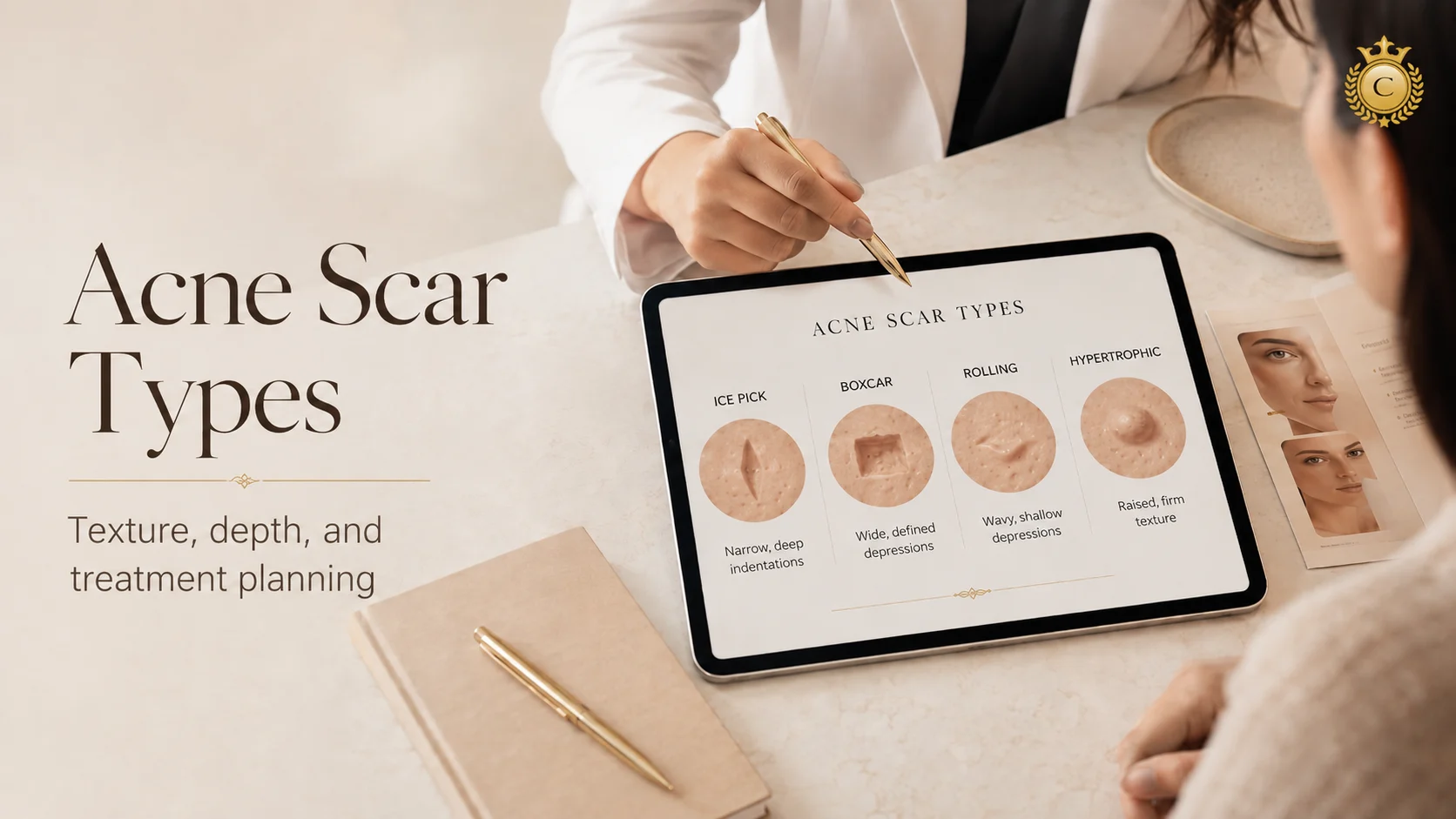
Understanding scar type helps guide treatment planning.
Ice Pick Scars
Ice pick scars are narrow, deep scars that look like tiny punctures in the skin. Because they are deep and sharply defined, they may not respond as well to surface-level treatments alone.
Boxcar Scars
Boxcar scars are wider depressions with more defined edges. They can be shallow or deeper. Some may respond to collagen-supporting treatments, while others may need more targeted approaches.
Rolling Scars
Rolling scars create a wave-like texture on the skin. They may become more visible in certain lighting because of how shadows fall across the skin.
Hypertrophic or Raised Scars
Raised acne scars form when the skin produces too much collagen during healing. These scars are different from depressed scars and often require a different treatment approach.
Are Red Acne Marks the Same as Acne Scars?
A flat red, pink or brown mark after a pimple is not necessarily a scar. The AAD distinguishes flat post-acne colour changes from depressed or raised scars that alter the skin’s contour. Colour changes and textural scars can occur together, so a photograph or the phrase “red acne scar” does not establish what needs treatment.
At assessment, describe both colour and texture, mention ongoing breakouts, and ask which concern the proposed plan addresses. Do not assume a texture-focused procedure will address redness or pigmentation in the same way.
Scar Concern vs. Assessment Question
| Concern | Question to resolve first |
|---|---|
| Flat colour left after acne | Is this a pigment or redness concern rather than a change in contour? |
| Indented or uneven texture | Which scar shapes and depths are present, and would one approach address them all? |
| Deep, raised or thickened areas | Is specialist assessment or referral appropriate? |
| Ongoing breakouts | Should active acne care come before a scar procedure? |
This table is educational only. Treatment recommendations depend on assessment.
Separate Scar Treatment from Other Skin Goals
| Goal | Important distinction |
|---|---|
| Changing scar texture | Needs assessment of the actual scar, skin and treatment history. |
| Hydration or general skin quality | A separate goal; a skin-quality service is not evidence that a scar will be corrected. |
| Reducing flat post-acne marks | Requires a different discussion from depressed or raised scars. |
| Planning several procedures | Ask why each is needed, its risks and when the plan will be reviewed. |
This table helps separate scar treatment from active acne care, pigment management, and general skin-quality support. The right direction depends on the skin assessment.
Why One Treatment Does Not Work for Every Scar
Acne scars vary in depth, shape, firmness, and cause. A treatment that may improve shallow texture may not significantly improve deeper ice pick scars. A treatment that supports collagen may not be the right choice for active acne, pigmentation, or raised scars.
This is why acne scar treatment in Thornhill or Newmarket should begin with a skin assessment, not a menu of procedures.
- A good consultation should ask:
- Are the scars depressed, raised, or pigmented?
- Is there active acne?
- Is the skin sensitive or reactive?
- Has the client used isotretinoin or strong acne medication recently?
- What is the client’s skin tone and pigmentation risk?
- How much downtime is acceptable?
- Is gradual improvement acceptable?
- Would a combination approach be more appropriate?
Consultation Tip
Bring photos of your skin during different lighting if your scars appear worse in certain conditions. Acne scars often look different in overhead light, natural light, and close-up mirrors.
Important
Active acne should usually be managed before beginning acne scar treatment. Treating texture while breakouts are still inflamed can increase irritation and may not address the cause of ongoing scarring.
What Does Acne Scar Resurfacing Mean for Your Plan?
If you have searched for acne scar resurfacing, ask which exact procedure is being proposed. The AAD discusses several distinct scar-treatment approaches; the term does not identify one standard treatment or show that every option is offered at Classy. Ask why a particular method fits your scar type, what improvement is realistic, and what risks, recovery and alternatives apply.
Even apparently mild acne scars need an assessment of shape, depth, skin history and active breakouts. An online description of mild scarring cannot determine a suitable procedure or number of sessions.
Microneedling for Acne Scars
Microneedling is often discussed for acne scars because it creates controlled micro-channels in the skin. This process may encourage the skin’s natural repair response and support collagen remodeling over time.
For selected clients, microneedling may help improve:
- Uneven skin texture
- Shallow acne scars
- Enlarged-looking pores
- Mild rolling scars
- Overall skin smoothness
- Skin rejuvenation goals
Microneedling is not instant scar removal. Improvement is typically gradual, and a series of sessions may be recommended depending on scar type, skin response, and treatment goals.
At Classy Cosmetic Clinic, microneedling may be discussed when the concern is texture-focused and the skin is suitable for collagen-supportive treatment.
How PRP May Be Discussed Alongside Microneedling
PRP is prepared from a person’s blood sample. The American Academy of Dermatology describes PRP as an option dermatologists may use with another treatment, including microneedling, for selected acne scars. This does not mean a facial package or PRP alone will correct every scar.
Ask the clinician to explain the proposed method, why it is relevant to your scars, what benefit remains uncertain, and what added risks, recovery and cost it involves. Confirm the actual service offered at the chosen branch rather than assuming all methods described in general medical guidance are available at Classy.
Microneedling vs. PRP Facial
| Discussion | Microneedling | PRP with another treatment |
|---|---|---|
| What it involves | A procedure using small needles to stimulate a repair response. | Platelets prepared from a blood sample; the method and accompanying procedure need explanation. |
| Why it may be considered | Selected scar and texture concerns after assessment. | An adjunct in an individual plan, rather than a substitute for identifying scar type. |
| What to ask | Suitability, risks, expected improvement, recovery and alternatives. | Reason for adding it, supporting evidence, added risks and cost. |
Combination Treatment Approaches
Some acne scars respond better to a staged plan than a single treatment. For example, microneedling may be discussed for texture, while PRP Facial may be considered for skin quality support. Skin boosters may be discussed if hydration, smoothness, or skin quality are also priorities.
In some cases, dermal fillers may be considered for selected depressed scars, but this is highly case-dependent and should not be assumed. Fillers are more commonly used for facial volume and contouring, so they should only be discussed for acne scars when the scar type and anatomy make it relevant.
Combination care should be conservative and purposeful. More treatments do not automatically mean better results.
Patient Expectation
Acne scar improvement is usually gradual. Many clients need more than one session, and complete removal should not be promised.
Who May Benefit from Acne Scar Treatment?
Acne scar treatment may be suitable for clients who:
- Have mild to moderate textural acne scars
- Are bothered by uneven skin texture
- Do not have an active acne flare in the treatment area
- Understand that gradual improvement is more realistic than complete removal
- Can follow aftercare instructions
- Are open to a series or staged plan if recommended
- Want a consultation-first approach
The best candidates are often people whose acne is reasonably controlled and whose main concern is texture rather than active inflammation.
Who May Not Be a Suitable Candidate?
A provider may recommend delaying acne scar treatment or choosing another approach if there is:
- Active inflamed acne in the treatment area
- Active infection, irritation, or open skin
- A history of problematic scarring or keloids
- Recent use of certain acne medications or procedures
- Pregnancy or breastfeeding considerations
- Uncontrolled skin conditions
- Unrealistic expectations
- Desire for instant scar removal
- Severe scarring that may require referral or more advanced treatment
This does not automatically mean treatment is impossible. It means a consultation is needed to determine the safest and most appropriate next step.
What to Expect During Consultation
During consultation at Classy Cosmetic Clinic, the provider may assess:
- Scar type and depth
- Skin tone and pigmentation risk
- Active acne status
- Skin sensitivity
- Previous treatments
- Medical history
- Current skincare routine
- Downtime tolerance
- Treatment goals
The consultation may include discussion of microneedling, PRP Facial, skin boosters, or other skin rejuvenation options. If volume or contour is also a concern, dermal fillers may be discussed separately.
The goal is to recommend the right treatment category, not to push a single procedure.
Recovery and Aftercare Expectations
Recovery depends on the treatment type and skin sensitivity.
After microneedling, temporary redness, warmth, tightness, dryness, sensitivity, or mild swelling may occur. The skin may feel sunburned for a short period. After PRP Facial, redness, tenderness, mild swelling, or sensitivity may occur, especially if combined with microneedling.
Aftercare may include:
- Avoiding harsh skincare for a short period
- Using gentle cleanser and moisturizer
- Avoiding sun exposure
- Wearing sunscreen
- Avoiding intense exercise or heat for a short time
- Following clinic-specific instructions
Results develop gradually as the skin repairs and remodels. A series may be recommended, and maintenance may be discussed depending on the concern.
Safety Considerations
Acne scar treatments should be planned carefully, especially for clients with darker skin tones, active acne, sensitive skin, or a history of pigmentation.
Potential risks may include:
- Redness
- Swelling
- Sensitivity
- Dryness
- Bruising
- Temporary pigmentation changes
- Infection
- Irritation
- Worsening inflammation if treated at the wrong time
This is why professional assessment matters. The safest plan may be to treat active acne first, delay scar treatment, or choose a gentler approach.
Acne Scar Treatment in Thornhill & Newmarket
Classy Cosmetic Clinic serves clients in Thornhill and Newmarket with a consultation-first approach to medical aesthetics.
Thornhill:
7163 Yonge Street Suite 269, Thornhill, Ontario L3T 0C6
Newmarket:
16775 Yonge Street Suite 217, Newmarket, Ontario L3X 2P8
If you are searching for Acne Scar Treatment in Thornhill or Acne Scar Treatment in Newmarket, the most important step is understanding your specific scar type.
A professional consultation at Classy Cosmetic Clinic is essential to determine whether microneedling, PRP Facial, skin boosters, or another medical aesthetic option may be the most suitable approach for your unique skin needs.
Frequently Asked Questions
Why do acne scars form?
What are the different types of acne scars?
Is microneedling suitable for acne scars?
Can PRP Facial improve acne scars?
Can acne scar treatments be combined with Skin Boosters?
How many sessions may be recommended?
What is recovery like?
Can acne scar treatments be combined?
Who may not be suitable for acne scar treatment?
Conclusion: Acne Scar Treatment Should Begin With Scar Type
Acne scar treatment is most effective when it starts with understanding the type of scar and the condition of the skin. Microneedling, PRP Facial, skin boosters, and combination plans may each have a role, but no single treatment works for every acne scar.
If you are considering acne scar treatment in Thornhill or Newmarket, consultation is the best way to understand your options, set realistic expectations, and choose a plan that fits your skin.
To speak with Classy Cosmetic Clinic, contact the clinic at
classycosmeticclinic@gmail.com,
call
647 909 5026,
or visit the
Contact page.
Service Information and Sources
See Classy’s acne scar service information and Newmarket branch for enquiries. For related reading, the microneedling and hyaluronic acid guide helps separate the procedure from products discussed around it. The PRP facial evidence and limitations guide explains a separate treatment discussion. These articles do not replace an individual scar assessment. You can also confirm enquiries with the Thornhill branch.
- AAD: Acne scars, signs and symptoms
- AAD: Acne scar consultation and treatment
- CNO: Obtaining informed consent
Educational information; not an individual diagnosis or treatment recommendation. Existing illustrations are explanatory, not evidence of a patient result.